Application
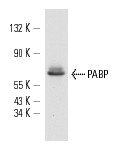
Western blot analysis of PABP expression in mouse testis tissue extract.Application
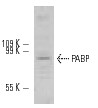
Western blot analysis of PABP expression in HeLa whole cell lysate.| Product Name | PABP Antibody (H-300) |
|---|---|
| Antibody Type | Primary Antibodies |
| Modification Notes | PABP, for Poly(A)-binding protein, is an essential, well-conserved, multifunctional protein involved in translational initiation, mRNA biogenesis and degradation. PABP is required for the shortening of the 3' poly(A) tail of eukaryotic mRNA and translation initiation. The interaction between PABP and eukaryotic translation initiation factor 4G (eIF4G) facilitates translational initiation of polyadenylated mRNAs. This interaction is mediated, at least in part, by elF4G, which bridges the mRNA termini by simultaneously binding PABP and the cap-binding protein, elF4E. With lower affinities, PABP can also associate with non-poly(A) sequences. The physiological consequences of these PABP/RNA interactions are far from clear but may include functions such as translational silencing. PABP is a modular protein, with four N-terminal RNA-binding domains and an extensive C-terminus. During poliovirus infection, cleavage of eIF4GII and PABP have been proposed to contribute to complete host translation shutoff. The human PABP gene maps to chromosome 8q22.2-q23 and encodes a 633 amino acid protein. |
| Clonality | Polyclonal |
|---|---|
| Isotype | IgG |
| Host Species | Rabbit |
| Tested Applications | WBIPIFELISA |
| recommended for detection of PABP1, 2, 3, 4 and 5 of mouse, rat and human origin by WB, IP, IF and ELISA also reactive with additional species, including canine | |
| Species Reactivity | HumanMouseRat |
| Concentration | 1mg/ml |
| Purification | Affinity purified |
| Alternative Names | epitope corresponding to amino acids 1-300 (deletion 82-129) mapping at the N-terminus of PABP of human origin |
|---|---|
| Tissue Specificity | epitope corresponding to amino acids 1-300 (deletion 82-129) mapping at the N-terminus of PABP of human origin |
| Entrez Gene | 26986 |
|---|
Application
Western blot analysis of PABP expression in mouse testis tissue extract.
Application
Western blot analysis of PABP expression in HeLa whole cell lysate.| Application Notes | recommended for detection of PABP1, 2, 3, 4 and 5 of mouse, rat and human origin by WB, IP, IF and ELISA also reactive with additional species, including canine |
|---|
| Form | Liquid |
|---|---|
| Storage Instructions | For short-term storage, store at 4° C. For long-term storage, aliquot and store at -20ºC or below. Avoid multiple freeze-thaw cycles. |
| Storage Buffer | phosphate buffered saline , pH 7.4, 150mM NaCl, 0.02% sodium azide and 50% glycerol. |


