Application
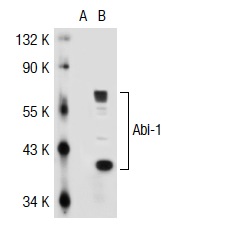
Western blot analysis of Abi-1 expression in non-transfected: (A) and mouse Abi-1 transfected: (B) 293T whole cell lysates.| Product Name | Abi-1 Antibody (H-80) |
|---|---|
| Antibody Type | Primary Antibodies |
| Modification Notes | The Abelson oncogene was initially identified as the viral transforming component of Abelson murine leukemia virus (A-MuLV). The Abelson gene (ABL1) encodes a SH2-domain bearing tyrosine kinase which conducts mitogenic signaling pursuant to growth factor receptor ligation. The Abl interactor proteins, Abi-1 and Abi-2, are SH3-domain containing proteins that bind to the proline-rich motifs of Abl and activate the kinase function. Two splice variants of Abi-1 are widely expressed, with the highest levels found in bone marrow, spleen, brain and testis. Abi-1 and Abi-2 are thought to negatively regulate cell growth and transformation, including cellular transformation through v-Abl. ABI1, the gene encoding Abi-1, has been shown to translocate and fuse with MLL (mixed lineage leukemia) gene in some cases of acute myeloid leukemia (AML). The Abi proteins have also been identified as mediators of cell motility by regulating Actin polymerization in lamellipodia and filopodia. |
| Clonality | Polyclonal |
|---|---|
| Isotype | IgG |
| Host Species | Rabbit |
| Tested Applications | WBIPIFELISA |
| recommended for detection of Abi-1 of mouse, rat and human origin by WB, IP, IF and ELISA also reactive with additional species, including equine, canine, porcine and avian | |
| Species Reactivity | HumanMouseRat |
| Concentration | 1mg/ml |
| Purification | Affinity purified |
| Alternative Names | epitope corresponding to amino acids 271-350 mapping within an internal region of Abi-1 of human origin |
|---|---|
| Tissue Specificity | epitope corresponding to amino acids 271-350 mapping within an internal region of Abi-1 of human origin |
| Entrez Gene | 10006 |
|---|
Application
Western blot analysis of Abi-1 expression in non-transfected: (A) and mouse Abi-1 transfected: (B) 293T whole cell lysates.| Application Notes | recommended for detection of Abi-1 of mouse, rat and human origin by WB, IP, IF and ELISA also reactive with additional species, including equine, canine, porcine and avian |
|---|
| Form | Liquid |
|---|---|
| Storage Instructions | For short-term storage, store at 4° C. For long-term storage, aliquot and store at -20ºC or below. Avoid multiple freeze-thaw cycles. |
| Storage Buffer | phosphate buffered saline , pH 7.4, 150mM NaCl, 0.02% sodium azide and 50% glycerol. |


