Application
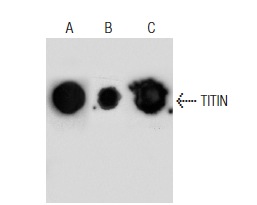
Dot blot analysis of Titin expression in A-10 (A), SJRH30 (B) and Sol8 (C) whole cell lysates immunoprecipitated with Titin (H-300): and detected with Titin (E-2): .| Product Name | Titin Antibody (H-300) |
|---|---|
| Antibody Type | Primary Antibodies |
| Modification Notes | Titin, also known as connectin, is a large protein involved in the temporal and spatial control of the assembly of the highly ordered sarcomeres (contractile units) of striated muscle. In addition to sarcomere assembly Titin also functions to maintain the structural integrity of the contracting myofibrils within the muscle and to organize the machinery for condensation of chromosomes in dividing cells. Titin is a giant protein composed of 27,000 amino acids and contains an autoregulated serine kinase catalytic domain as well as a calcium/calmodulin binding region that are involved in its activation. Activated Titin phosphorylates the muscle protein telethonin, a sarcomeric protein abundant in heart and skeletal muscle, implicating Titin activity in the reorganization of the cytoskeleton during myofibrillogenesis. |
| Clonality | Polyclonal |
|---|---|
| Isotype | IgG |
| Host Species | Rabbit |
| Tested Applications | IPIFELISA |
| recommended for detection of Titin of human origin by IP, IF and ELISA also reactive with additional species, including canine and bovine | |
| Species Reactivity | HumanMouseRat |
| Concentration | 1mg/ml |
| Purification | Affinity purified |
| Alternative Names | epitope corresponding to amino acids 33124-33423 mapping at the C-terminus of Titin of human origin |
|---|---|
| Tissue Specificity | epitope corresponding to amino acids 33124-33423 mapping at the C-terminus of Titin of human origin |
| Entrez Gene | 7273 |
|---|
Application
Dot blot analysis of Titin expression in A-10 (A), SJRH30 (B) and Sol8 (C) whole cell lysates immunoprecipitated with Titin (H-300): and detected with Titin (E-2): .| Application Notes | recommended for detection of Titin of human origin by IP, IF and ELISA also reactive with additional species, including canine and bovine |
|---|
| Form | Liquid |
|---|---|
| Storage Instructions | For short-term storage, store at 4° C. For long-term storage, aliquot and store at -20ºC or below. Avoid multiple freeze-thaw cycles. |
| Storage Buffer | phosphate buffered saline , pH 7.4, 150mM NaCl, 0.02% sodium azide and 50% glycerol. |


