Application
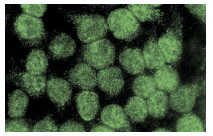
Immunofluorescence staining of methanol-fixed HeLa cells showing nuclear localization.Application
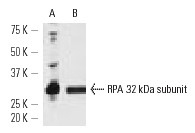
Western blot analysis of RPA 32 kDa subunit expression in H69AR (A) and HeLa (B) whole cell lysates.| Product Name | RPA 32 kDa subunit Antibody (H-100) |
|---|---|
| Antibody Type | Primary Antibodies |
| Modification Notes | The single-stranded-DNA-binding proteins (SSBs) are essential for DNA function in prokaryotic and eukaryotic cells, mitochondria, phages and viruses. Replication protein A (RPA), a highly conserved eukaryotic protein, is a heterotrimeric SSB. RPA plays an important role in DNA replication, recombination and repair. The binding of human RPA (hRPA) to DNA involves molecular polarity in which initial hRPA binding occurs on the 5' side of a ssDNA substrate and then extends in the 3' direction to create a stably bound hRPA. RPA is a major damage-recognition protein involved in the early stages of nucleotide excision repair. It can also play a role in telomere maintenance. The C-terminus of RPA 32 can specfically intereact with the DNA repair enzyme UNG2 and repair factors XPA and Rad52, each of which functions in a different repair pathway. In addition, RPA 32 binds specifically to the SH2 domain of Stat3 in vivo, and overexpression of RPA 32 corresponds to the augmented growth factor-stimulated tyrosine phosphorylation and transcription activities of Stat3. |
| Clonality | Polyclonal |
|---|---|
| Isotype | IgG |
| Host Species | Rabbit |
| Tested Applications | WBIPIFELISAGSChIP |
| recommended for detection of RPA 32 kDa subunit of mouse, rat and human origin by WB, IP, IF and ELISA also reactive with additional species, including equine, canine, bovine and porcine | |
| Species Reactivity | HumanMouseRat |
| Concentration | 1mg/ml |
| Purification | Affinity purified |
| Alternative Names | epitope corresponding to amino acids 155-254 mapping within an internal region of RPA 32 kDa subunit of human origin |
|---|---|
| Tissue Specificity | epitope corresponding to amino acids 155-254 mapping within an internal region of RPA 32 kDa subunit of human origin |
| Entrez Gene | 6118 |
|---|
Application
Immunofluorescence staining of methanol-fixed HeLa cells showing nuclear localization.
Application
Western blot analysis of RPA 32 kDa subunit expression in H69AR (A) and HeLa (B) whole cell lysates.| Application Notes | recommended for detection of RPA 32 kDa subunit of mouse, rat and human origin by WB, IP, IF and ELISA also reactive with additional species, including equine, canine, bovine and porcine |
|---|
| Form | Liquid |
|---|---|
| Storage Instructions | For short-term storage, store at 4° C. For long-term storage, aliquot and store at -20ºC or below. Avoid multiple freeze-thaw cycles. |
| Storage Buffer | phosphate buffered saline , pH 7.4, 150mM NaCl, 0.02% sodium azide and 50% glycerol. |


