Application
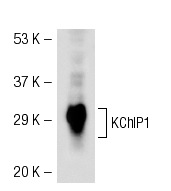
Western blot analysis of KChIP1 expression in mouse brain tissue extract.Application
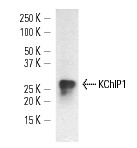
Western blot analysis of KChIP1 expression in rat small intestine tissue extract.| Product Name | KChIP1 Antibody (H-55) |
|---|---|
| Antibody Type | Primary Antibodies |
| Modification Notes | In the brain and heart, rapidly inactivating (A-type) voltage-gated potassium (Kv) currents control the excitability of neurons and cardiac myocytes. KChIPs are Kv channel-interacting proteins that bind to the cytoplasmic amino termini of Kv4a-subunits and are integral components of native Kv4 channel complexes. KChIP family members include KChIP1 expressed in brain, KChIP2 expressed in heart, brain, and lung, and KChIP3 (previously identified as calsenilin) expressed in brain and testis. In rat brain, KChIP1 colocalizes with Kv4.3 in granule cells and KChIP2 colocalizes with Kv4.2 in both neocoritcal and subcortical structures. The KChIPs are members of the recoverin/neuronal calcium sensor-1 subfamily of calcium-binding proteins and show 99% nucleotide homology to DREAM, suggesting that KChIPs may have activity beyond modulation of Kv4 channels. |
| Clonality | Polyclonal |
|---|---|
| Isotype | IgG |
| Host Species | Rabbit |
| Tested Applications | WBIPIFELISA |
| recommended for detection of KChIP1, and, to a lesser extent, KChIP2 of mouse, rat and human origin by WB, IP, IF and ELISA also reactive with additional species, including equine, canine, bovine and porcine | |
| Species Reactivity | HumanMouseRat |
| Concentration | 1mg/ml |
| Purification | Affinity purified |
| Alternative Names | epitope corresponding to amino acids 1-55 mapping at the N-terminus of KChIP1 of human origin |
|---|---|
| Tissue Specificity | epitope corresponding to amino acids 1-55 mapping at the N-terminus of KChIP1 of human origin |
| Entrez Gene | 30820 |
|---|
Application
Western blot analysis of KChIP1 expression in mouse brain tissue extract.
Application
Western blot analysis of KChIP1 expression in rat small intestine tissue extract.| Application Notes | recommended for detection of KChIP1, and, to a lesser extent, KChIP2 of mouse, rat and human origin by WB, IP, IF and ELISA also reactive with additional species, including equine, canine, bovine and porcine |
|---|
| Form | Liquid |
|---|---|
| Storage Instructions | For short-term storage, store at 4° C. For long-term storage, aliquot and store at -20ºC or below. Avoid multiple freeze-thaw cycles. |
| Storage Buffer | phosphate buffered saline , pH 7.4, 150mM NaCl, 0.02% sodium azide and 50% glycerol. |


