Application
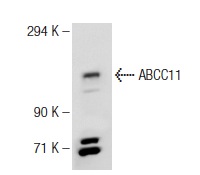
Western blot analysis of ABCC11 expression in AML-193 whole cell lysate.Application
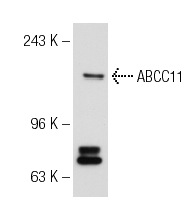
Western blot analysis of ABCC11 expression in SK-N-SH whole cell lysate.| Product Name | ABCC11 Antibody (H-215) |
|---|---|
| Antibody Type | Primary Antibodies |
| Antigen Alias | epitope corresponding to amino acids 929-1144 of ABCC11 of human origin |
| Modification Notes | ATP-binding cassette (ABC) transporters belong to an evolutionarily conserved family of proteins that catalyze the transport of molecules across extra- and intracellular membranes through the energy of ATP hydrolysis. ABC genes comprise seven subfamilies, designated ABC1, MDR/TAP, MRP, ALD, OABP, GCN20 and White (1). The complete human ABCC subfamily has 12 identified members (ABCC1–12), nine from the multidrug resistance-like subgroup, two from the sulfonylurea receptor subgroup, and the CFTR gene (2). The human ABCC11 gene maps to chromosome 16q12.1 and encodes a 1,382 amino acid protein (1–4). The human ABCC12 gene maps to chromosome 16q12.1 and encodes a 1,359 amino acid protein (1,4). Transcripts of ABCC11 and ABCC12 genes are present in various adult human tissues, including liver, lung and kidney, and also in several fetal tissues (3,4). Their chromosomal localization, potential function and expression patterns identify them as candidates for paroxysmal kinesigenic choreoathetosis, a disorder characterized by attacks of involuntary movements and postures, chorea and dystonia (1,3). Other inherited disorders where ABC transporters are implicated include cystic fibrosis, neurological disease, retinal degeneration, cholesterol and bile transport defects, anemia and drug response (5,6). |
| Clonality | Polyclonal |
|---|---|
| Isotype | IgG |
| Host Species | Rabbit |
| Tested Applications | WBIPIFELISA |
| recommended for detection of ABCC11 of human origin by WB, IP, IF and ELISA: |
|
| Species Reactivity | HumanMouseRat |
| Concentration | 1mg/ml |
| Purification | Affinity purified |
| Alternative Names | epitope corresponding to amino acids 929-1144 of ABCC11 of human origin |
|---|---|
| Tissue Specificity | epitope corresponding to amino acids 929-1144 of ABCC11 of human origin |
| Entrez Gene | 85320 |
|---|
Application
Western blot analysis of ABCC11 expression in AML-193 whole cell lysate.
Application
Western blot analysis of ABCC11 expression in SK-N-SH whole cell lysate.| Application Notes | recommended for detection of ABCC11 of human origin by WB, IP, IF and ELISA: |
|---|
| Form | Liquid |
|---|---|
| Storage Instructions | For short-term storage, store at 4° C. For long-term storage, aliquot and store at -20ºC or below. Avoid multiple freeze-thaw cycles. |
| Storage Buffer | phosphate buffered saline , pH 7.4, 150mM NaCl, 0.02% sodium azide and 50% glycerol. |


