Application
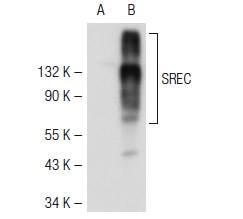
Western blot analysis of SREC expression in non-transfected: (A) and human SREC transfected: (B) 293T whole cell lysates.Application
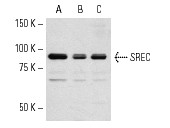
Western blot analysis of SREC expression in HeLa (A), ECV304 (B) and A-431 (C) whole cell lysates.| Product Name | SREC Antibody (H-299) |
|---|---|
| Antibody Type | Primary Antibodies |
| Antigen Alias | epitope corresponding to amino acids 532-830 of SREC of human origin |
| Modification Notes | Scavenger receptors mediate the endocytosis and degradation of chemically modified low density lipoproteins (LDL), such as acetylated LDL (Ac-LDL) and oxidized LDL (Ox-LDL). The scavenger receptor expressed by endothelial cells (SREC) primarily binds Ac-LDL and aids in its degradation. However, it has been shown to bind other ligands such as Ox-LDL, which suggests that SREC has a binding specificity similar to the type I and II macrophage scavenger receptors. SREC is expressed in HUVEC, CAE, and CASM cell lines. It is characterized by an extra-cellular amino-terminal domain with five epidermal growth factor-like cysteine pattern signatures and an unusually long cytoplasmic carboxy-terminal domain. SREC is thought to be involved in the development of atherosclerosis as it mediates the recruitment, activation, and transformation of macrophages after endothelial cell injury. |
| Clonality | Polyclonal |
|---|---|
| Isotype | IgG |
| Host Species | Rabbit |
| Tested Applications | WBIPIFELISA |
| recommended for detection of SREC of mouse, rat and human origin by WB, IP, IF and ELISA: |
|
| Species Reactivity | HumanMouseRat |
| Concentration | 1mg/ml |
| Purification | Affinity purified |
| Alternative Names | epitope corresponding to amino acids 532-830 of SREC of human origin |
|---|---|
| Tissue Specificity | epitope corresponding to amino acids 532-830 of SREC of human origin |
| Entrez Gene | 8578 |
|---|
Application
Western blot analysis of SREC expression in non-transfected: (A) and human SREC transfected: (B) 293T whole cell lysates.
Application
Western blot analysis of SREC expression in HeLa (A), ECV304 (B) and A-431 (C) whole cell lysates.| Application Notes | recommended for detection of SREC of mouse, rat and human origin by WB, IP, IF and ELISA: |
|---|
| Form | Liquid |
|---|---|
| Storage Instructions | For short-term storage, store at 4° C. For long-term storage, aliquot and store at -20ºC or below. Avoid multiple freeze-thaw cycles. |
| Storage Buffer | phosphate buffered saline , pH 7.4, 150mM NaCl, 0.02% sodium azide and 50% glycerol. |


