Application
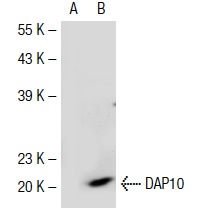
Western blot analysis of DAP10 expression in non-transfected: (A) and human DAP10 transfected: (B) 293T whole cell lysates.| Product Name | DAP10 Antibody (FL-93) |
|---|---|
| Antibody Type | Primary Antibodies |
| Antigen Alias | epitope corresponding to amino acids 1-93 representing full length DAP10 of human origin |
| Modification Notes | DAP10, a transmembrane type 1 protein, is predominantly expressed in hematopoietic cells (1). On SDS-PAGE, DAP10 migrates slightly slower than expected due to glycosylation (1). DAP10 forms an activating receptor complex with its physiological partner, NKG2D (1). NKG2D is an activating receptor that initiates Natural Killer and T-cell mediated cytotoxicity against tumors expressing its ligands MICA and MICB (2). The DAP10-NKG2D complex, as well as MICA and MICB, are stress-inducible molecules expressed in epithelial tumors (3). Both DAP10 and NKG2D contain inhibition motifs in their cytoplasmic domains that recruit tyrosine-phosphatases, resulting in the inactivation of Natural Killer cells (4). The cytoplasmic region of DAP10 also contains a binding site for the SH2 domain of the p85 subunit of PI 3-kinase which suggests a role for DAP10 as a signal transducer leading to PI 3-kinase activation (1,5). |
| Clonality | Polyclonal |
|---|---|
| Isotype | IgG |
| Host Species | Rabbit |
| Tested Applications | WBIPIFELISA |
| recommended for detection of DAP10 of mouse, rat and human origin by WB, IP, IF and ELISA: |
|
| Species Reactivity | HumanMouseRat |
| Concentration | 1mg/ml |
| Purification | Affinity purified |
| Alternative Names | epitope corresponding to amino acids 1-93 representing full length DAP10 of human origin |
|---|---|
| Tissue Specificity | epitope corresponding to amino acids 1-93 representing full length DAP10 of human origin |
| Entrez Gene | 10870 |
|---|
Application
Western blot analysis of DAP10 expression in non-transfected: (A) and human DAP10 transfected: (B) 293T whole cell lysates.| Application Notes | recommended for detection of DAP10 of mouse, rat and human origin by WB, IP, IF and ELISA: |
|---|
| Form | Liquid |
|---|---|
| Storage Instructions | For short-term storage, store at 4° C. For long-term storage, aliquot and store at -20ºC or below. Avoid multiple freeze-thaw cycles. |
| Storage Buffer | phosphate buffered saline , pH 7.4, 150mM NaCl, 0.02% sodium azide and 50% glycerol. |


