Application
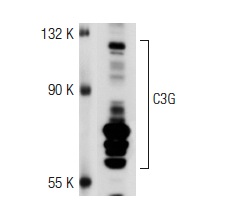
Western blot analysis of C3G expression in K-562 whole cell lysate.Application
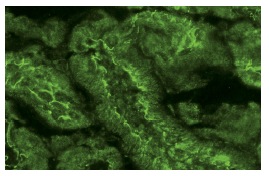
Immunofluorescence staining of normal mouse kidney frozen section showing cytoplasmic staining.| Product Name | C3G Antibody (C-19) |
|---|---|
| Antibody Type | Primary Antibodies |
| Antigen Alias | epitope mapping at the C-terminus of C3G of human origin |
| Modification Notes | Ras p21 is the prototype of a superfamily of GTPases that is involved in the regulation of a wide variety of cellular processes. Ras signals in its GTP-bound form but is “turned off” when bound to GDP. When unregulated or constitutively turned on by mutations, Ras signaling contributes to malignant transformation. The switch between active and inactive Ras is controlled by GTPase-activating proteins (GAPs) and guanine nucleotide exchange factors (GEFs). C3G was isolated in a screen for proteins that could bind the SH3 domain of the Crk proto-oncogene product. The carboxy-terminus of the C3G protein displays significant sequence similarity to Ras-GRF/Cdc25Mm and mSos and can substitute for Cdc25 function in S. cerevisiae. These observations strongly suggest that C3G is a GEF for Ras and is involved in the regulation of Ras signaling through Crk. The C3G gene maps to human chromosome 9q34.3 in proximity to the gene that encodes c-Abl, a proto-oncogene that regulates Crk. |
| Clonality | Polyclonal |
|---|---|
| Isotype | IgG |
| Host Species | Rabbit |
| Tested Applications | WBIPIFELISA |
| recommended for detection of C3G of mouse, rat and human origin by WB, IP, IF and ELISA also reactive with additional species, including equine, canine, bovine, porcine and avian: |
|
| Species Reactivity | HumanMouseRat |
| Concentration | 1mg/ml |
| Purification | Affinity purified |
| Alternative Names | epitope mapping at the C-terminus of C3G of human origin |
|---|---|
| Tissue Specificity | epitope mapping at the C-terminus of C3G of human origin |
| Entrez Gene | 2889 |
|---|
Application
Western blot analysis of C3G expression in K-562 whole cell lysate.
Application
Immunofluorescence staining of normal mouse kidney frozen section showing cytoplasmic staining.| Application Notes | recommended for detection of C3G of mouse, rat and human origin by WB, IP, IF and ELISA also reactive with additional species, including equine, canine, bovine, porcine and avian: |
|---|
| Form | Liquid |
|---|---|
| Storage Instructions | For short-term storage, store at 4° C. For long-term storage, aliquot and store at -20ºC or below. Avoid multiple freeze-thaw cycles. |
| Storage Buffer | phosphate buffered saline , pH 7.4, 150mM NaCl, 0.02% sodium azide and 50% glycerol. |


