Application
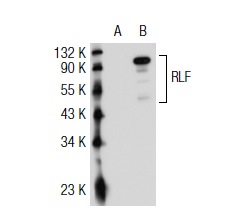
Western blot analysis of RLF expression in non-transfected: (A) and human RLF transfected: (B) 293T whole cell lysates.| Product Name | RLF Antibody (H-120) |
|---|---|
| Antibody Type | Primary Antibodies |
| Antigen Alias | epitope corresponding to amino acids 131-250 mapping to an internal region of RLF of human origin |
| Modification Notes | c-Jun is an important transcription factor that is involved in the regulation of proliferation, differentiation and cellular transformation induced by oncogenic Ras. An activated Ras effector, RLF (also designated as Ras-associated protein Rab2L/RalGDS-like factor), a guanine nucleotide exchange factor (GEF) of the small GTPase Ral, induces the phosphorylation of Serines 63 and 73 of c-Jun. The RalGEF-Ral pathway plays an important role in Ras-dependent c-Jun phosphoryation. RLF functions as an intermediate between Ras and Ral pathways by binding to the GTP-bound form of Ras proteins through its C-terminal Ras-binding domain (RBD), which is very similar to that of RalGDS- RBD. RLF-induced Ral activation is stimulated by Ras. RLF, when targeted to the plasma membrane using the Ras farnesyl attachment site (RLF-CAAX), is constitutively active to induce both Ral activation and c-Fos promoter activity. RLF mediates a distinct Ras-induced signaling pathway to gene induction and RLF-CAAX stimulates both trancriptional activation and cell growth. Overexpression of RLF-CAAX induces neuroretina cell division, but has no effect on ERK activity, whereas inhibition of MEK blocks both Ras- and RLF-CAAX-induced differentiation, suggesting that RalGEFs induce differentiation depending on the basal MEK or ERK activity. |
| Clonality | Polyclonal |
|---|---|
| Isotype | IgG |
| Host Species | Rabbit |
| Tested Applications | WBIPIFELISA |
| recommended for detection of RLF of mouse, rat and human origin by WB, IP, IF and ELISA also reactive with additional species, including equine, canine, bovine and porcine: |
|
| Species Reactivity | HumanMouseRat |
| Concentration | 1mg/ml |
| Purification | Affinity purified |
| Alternative Names | epitope corresponding to amino acids 131-250 mapping to an internal region of RLF of human origin |
|---|---|
| Tissue Specificity | epitope corresponding to amino acids 131-250 mapping to an internal region of RLF of human origin |
| Entrez Gene | 5863 |
|---|
Application
Western blot analysis of RLF expression in non-transfected: (A) and human RLF transfected: (B) 293T whole cell lysates.| Application Notes | recommended for detection of RLF of mouse, rat and human origin by WB, IP, IF and ELISA also reactive with additional species, including equine, canine, bovine and porcine: |
|---|
| Form | Liquid |
|---|---|
| Storage Instructions | For short-term storage, store at 4° C. For long-term storage, aliquot and store at -20ºC or below. Avoid multiple freeze-thaw cycles. |
| Storage Buffer | phosphate buffered saline , pH 7.4, 150mM NaCl, 0.02% sodium azide and 50% glycerol. |


