Application
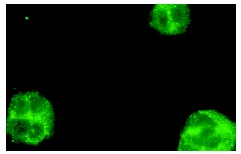
Immunofluorescence staining of methanol-fixed A-673 cells showing cytoplasmic staining.Application
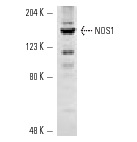
Western blot analysis of NOS1 expression in mouse brain tissue extract.| Product Name | NOS1 Antibody (K-20) |
|---|---|
| Antibody Type | Primary Antibodies |
| Antigen Alias | epitope mapping near the N-terminus of NOS1 of human origin |
| Modification Notes | Nitric oxide (NO) has a broad range of biological activities and has been implicated in signaling pathways in phylogenetically diverse species. Nitric oxide synthases (NOSs), the enzymes responsible for synthesis of NO, contain an N-terminal oxygenase domain and a C-terminal reductase domain. NOS activity requires homodimerization as well as three cosubstrates (L-arginine, NADPH and O2) and five cofactors or prosthetic groups (FAD, FMN, calmodulin, tetrahydrobiopterin and heme). Several distinct NOS isoforms have been described and been shown to represent the products of three distinct genes. These include two constitutive Ca2+/CaM-dependent forms of NOS, including NOS1 (also designated ncNOS) whose activity was first identified in neurons, and NOS3 (also designated ecNOS), first identified in endothelial cells. The inducible form of NOS, NOS2 (also designated iNOS), is Ca2+-independent and is expressed in a broad range of cell types. |
| Clonality | Polyclonal |
|---|---|
| Isotype | IgG |
| Host Species | Rabbit |
| Tested Applications | WBIPIFELISA |
| recommended for detection of NOS1 (ncNOS) of mouse, rat and human origin by WB, IP, IF and ELISA also reactive with additional species, including equine, canine, bovine, porcine and avian: |
|
| Species Reactivity | HumanMouseRat |
| Concentration | 1mg/ml |
| Purification | Affinity purified |
| Alternative Names | epitope mapping near the N-terminus of NOS1 of human origin |
|---|---|
| Tissue Specificity | epitope mapping near the N-terminus of NOS1 of human origin |
| Entrez Gene | 4842 |
|---|
Application
Immunofluorescence staining of methanol-fixed A-673 cells showing cytoplasmic staining.
Application
Western blot analysis of NOS1 expression in mouse brain tissue extract.| Application Notes | recommended for detection of NOS1 (ncNOS) of mouse, rat and human origin by WB, IP, IF and ELISA also reactive with additional species, including equine, canine, bovine, porcine and avian: |
|---|
| Form | Liquid |
|---|---|
| Storage Instructions | For short-term storage, store at 4° C. For long-term storage, aliquot and store at -20ºC or below. Avoid multiple freeze-thaw cycles. |
| Storage Buffer | phosphate buffered saline , pH 7.4, 150mM NaCl, 0.02% sodium azide and 50% glycerol. |


