Application
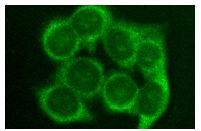
Immunofluorescence staining of methanol-fixed HeLa cells showing cytoplasmic and membrane staining.Application
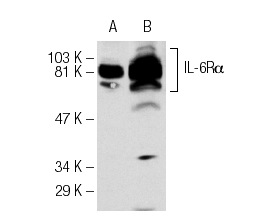
Western blot analysis of IL-6 receptor α expression in HeLa (A) and BJAB (B) whole cell lysates.| Product Name | IL-6Rα Antibody (C-20) |
|---|---|
| Antibody Type | Primary Antibodies |
| Antigen Alias | epitope mapping at the C-terminus of IL-6Rα of human origin |
| Modification Notes | IL-6 activates intracellular signaling through binding a receptor consisting of a ligand-binding protein (IL-6Rå) and a second protein. IL-6 first binds to IL-6Rå (also known as gp80), which subsequently associates with a gp130 dimer. The active signaling complex consists of, at minimum, IL-6, IL-6Rå and a dimer of two gp130 proteins that are linked by a disulfide bond. A soluble form of IL-6Rå, namely sIL-6Rå, is generated by proteolytic cleavage of the membrane-bound precursor and can function as an agonistic molecule that can actively participate in cell-to-cell signaling. The second subunit of the IL-6 complex, gp130, also functions as a component of several additional receptor complexes, including leukemia inhibitory factor (LIF), oncostatin M (OSM), ciliary neurotrophic factor (CNTF) and IL-11. LIF binds to the LIF receptor with low affinity and to a complex of the LIF receptor and gp130 with high affinity, while OSM appears to bind to gp130 with low affinity and to a complex of gp130 and the LIF receptor with high affinity. |
| Clonality | Polyclonal |
|---|---|
| Isotype | IgG |
| Host Species | Rabbit |
| Tested Applications | WBIPIFELISA |
| recommended for detection of IL-6Rα of human origin by WB, IP, IF and ELISA also reactive with additional species, including canine: |
|
| Species Reactivity | HumanMouseRat |
| Concentration | 1mg/ml |
| Purification | Affinity purified |
| Alternative Names | epitope mapping at the C-terminus of IL-6R&alpha of human origin |
|---|---|
| Tissue Specificity | epitope mapping at the C-terminus of IL-6Rα of human origin |
| Entrez Gene | 3570 |
|---|
Application
Immunofluorescence staining of methanol-fixed HeLa cells showing cytoplasmic and membrane staining.
Application
Western blot analysis of IL-6 receptor α expression in HeLa (A) and BJAB (B) whole cell lysates.| Application Notes | recommended for detection of IL-6Rα of human origin by WB, IP, IF and ELISA also reactive with additional species, including canine: |
|---|
| Form | Liquid |
|---|---|
| Storage Instructions | For short-term storage, store at 4° C. For long-term storage, aliquot and store at -20ºC or below. Avoid multiple freeze-thaw cycles. |
| Storage Buffer | phosphate buffered saline , pH 7.4, 150mM NaCl, 0.02% sodium azide and 50% glycerol. |


