Application
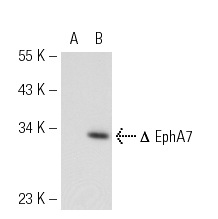
Western blot analysis of EphA7 expression in non-transfected: (A) and truncated human EphA7 transfected: (B) 293T whole cell lysates.Application
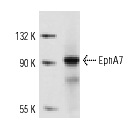
Western blot analysis of EphA7 expression in rat small intestine tissue extract.| Product Name | EphA7 Antibody (K-16) |
|---|---|
| Antibody Type | Primary Antibodies |
| Antigen Alias | epitope mapping at the N-terminus of EphA7 of mouse origin |
| Modification Notes | The Eph subfamily represents the largest group of receptor protein tyrosine kinases identified to date. The Eph subfamily receptors of human origin (and their murine/avian homologs) include EphA1 (Eph), EphA2 (Eck), EphA3 (Hek4), EphA4 (Hek8), EphA5 (Hek7), EphA6 (Hek12), EphA7 (Hek11/MDK1), EphA8 (Hek3), EphB1 (Hek6), EphB2 (Hek5), EphB3 (Cek10, Hek2), EphB4 (Htk), EphB5 (Hek9) and EphB6 (Mep). EphAs are a family of receptor tyrosine kinases that are involved in axonal guidance during development. These receptors and their ligands, the ephrins, act via repulsive mechanisms to guide growing axons towards their appropriate targets and allow for the correct developmental connections to be made. Ligand binding to an Eph receptor results in tyrosine phosphorylation of the kinase domain, and repulsion of axonal growth cones and migrating cells. During neurulation, ephrin-A5 is coexpressed with its cognate receptor EphA7 in cells at the edges of the dorsal neural folds. Three different EphA7 splice variants, a full-length form and two truncated versions lacking kinase domains, are expressed in the neural folds. |
| Clonality | Polyclonal |
|---|---|
| Isotype | IgG |
| Host Species | Rabbit |
| Tested Applications | WBIPIFELISA |
| recommended for detection of EphA7 of mouse, rat and human origin by WB, IP, IF and ELISA also reactive with additional species, including equine, canine, bovine, porcine and avian: |
|
| Species Reactivity | HumanMouseRat |
| Concentration | 1mg/ml |
| Purification | Affinity purified |
| Alternative Names | epitope mapping at the N-terminus of EphA7 of mouse origin |
|---|---|
| Tissue Specificity | epitope mapping at the N-terminus of EphA7 of mouse origin |
| Entrez Gene | 2045 |
|---|
Application
Western blot analysis of EphA7 expression in non-transfected: (A) and truncated human EphA7 transfected: (B) 293T whole cell lysates.
Application
Western blot analysis of EphA7 expression in rat small intestine tissue extract.| Application Notes | recommended for detection of EphA7 of mouse, rat and human origin by WB, IP, IF and ELISA also reactive with additional species, including equine, canine, bovine, porcine and avian: |
|---|
| Form | Liquid |
|---|---|
| Storage Instructions | For short-term storage, store at 4° C. For long-term storage, aliquot and store at -20ºC or below. Avoid multiple freeze-thaw cycles. |
| Storage Buffer | phosphate buffered saline , pH 7.4, 150mM NaCl, 0.02% sodium azide and 50% glycerol. |


