Application
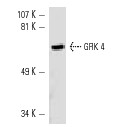
Western blot analysis of GRK 4 expression in rat testis tissue extract.| Product Name | GRK 4 Antibody (H-70) |
|---|---|
| Antibody Type | Primary Antibodies |
| Antigen Alias | epitope corresponding to amino acids 81-150 mapping near the N-terminus of GRK 4 of human origin |
| Modification Notes | Heterotrimeric G protein-mediated signal transduction is a dynamically regulated process with the intensity of signal decreasing over time despite the continued presence of the agonist. This phenomenon, referred to as agonist-mediated desensitization, involves phosphorylation of the receptor by two classes of enzymes. The first class is comprised of the second messenger-regulated kinases, such as c-AMP dependent protein kinase A and protein kinase C. The second class includes the G protein-coupled receptor kinases (GRKs). At least seven members of the GRK family have been identified. These include rhodopsin kinase (GRK 1), two forms of ∫-adrenergic receptor kinase: GRK 2 (∫ARK, ∫ARK1) and GRK 3 (∫ARK2), IT-11 (GRK 4), GRK 5, GRK 6 and GRK 7. Phosphorylation of receptors by GRKs appears to be strictly dependent on the receptor being in its agonist-activated state. |
| Clonality | Polyclonal |
|---|---|
| Isotype | IgG |
| Host Species | Rabbit |
| Tested Applications | WBIPIFELISA |
| recommended for detection of GRK 4 of mouse, rat and human origin by WB, IP, IF and ELISA cross-reactive with the α, β, γ and δ isoforms: |
|
| Species Reactivity | HumanMouseRat |
| Concentration | 1mg/ml |
| Purification | Affinity purified |
| Alternative Names | epitope corresponding to amino acids 81-150 mapping near the N-terminus of GRK 4 of human origin |
|---|---|
| Tissue Specificity | epitope corresponding to amino acids 81-150 mapping near the N-terminus of GRK 4 of human origin |
| Entrez Gene | 2868 |
|---|
Application
Western blot analysis of GRK 4 expression in rat testis tissue extract.| Application Notes | recommended for detection of GRK 4 of mouse, rat and human origin by WB, IP, IF and ELISA cross-reactive with the α, β, γ and δ isoforms: |
|---|
| Form | Liquid |
|---|---|
| Storage Instructions | For short-term storage, store at 4° C. For long-term storage, aliquot and store at -20ºC or below. Avoid multiple freeze-thaw cycles. |
| Storage Buffer | phosphate buffered saline , pH 7.4, 150mM NaCl, 0.02% sodium azide and 50% glycerol. |


