Application
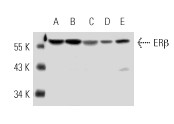
Western blot analysis of ERβ expression in I-11.15 (A), F9 (B) and NIH/3T3 (C) whole cell lysates and mouse thymus (D) and mouse spleen (E) tissue extracts.Application
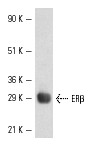
Western blot analysis of human recombinant ERβ fragment.| Product Name | ERβ Antibody (H-150) |
|---|---|
| Antibody Type | Primary Antibodies |
| Antigen Alias | epitope corresponding to amino acids 1-150 of ERβ of human origin |
| Modification Notes | Estrogen receptors (ER) are members of the steroid/thyroid hormone receptor superfamily of ligand-activated transcription factors. Estrogen receptors, including ERå and ER∫, contain DNA binding and ligand binding domains and are critically involved in regulating the normal function of reproductive tissues. They are located in the nucleus, though some estrogen receptors associate with the cell surface membrane and can be rapidly activated by exposure of cells to estrogen. ERå and ER∫ have been shown to be differentially activated by various ligands. Receptor-ligand interactions trigger a cascade of events, including dissociation from heat shock proteins, receptor dimerization, phosphorylation and the association of the hormone activated receptor with specific regulatory elements in target genes. Evidence suggests that ERå and ER∫ may be regulated by distinct mechanisms even though they share many functional characteristics. |
| Clonality | Polyclonal |
|---|---|
| Isotype | IgG |
| Host Species | Rabbit |
| Tested Applications | WBIPIFELISAGSChIP |
| recommended for detection of ERβ of mouse, rat and human origin by WB, IP, IF and ELISA: |
|
| Species Reactivity | HumanMouseRat |
| Concentration | 1mg/ml |
| Purification | Affinity purified |
| Alternative Names | epitope corresponding to amino acids 1-150 of ER&beta of human origin |
|---|---|
| Tissue Specificity | epitope corresponding to amino acids 1-150 of ERβ of human origin |
| Entrez Gene | 2100 |
|---|
Application
Western blot analysis of ERβ expression in I-11.15 (A), F9 (B) and NIH/3T3 (C) whole cell lysates and mouse thymus (D) and mouse spleen (E) tissue extracts.
Application
Western blot analysis of human recombinant ERβ fragment.| Application Notes | recommended for detection of ERβ of mouse, rat and human origin by WB, IP, IF and ELISA: |
|---|
| Form | Liquid |
|---|---|
| Storage Instructions | For short-term storage, store at 4° C. For long-term storage, aliquot and store at -20ºC or below. Avoid multiple freeze-thaw cycles. |
| Storage Buffer | phosphate buffered saline , pH 7.4, 150mM NaCl, 0.02% sodium azide and 50% glycerol. |


