Application
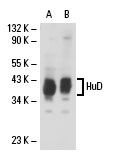
Western blot analysis of HuD expression in SK-N-SH whole cell lysate (A) and mouse brain tissue extract (B).| Product Name | HuD Antibody (H-300) |
|---|---|
| Antibody Type | Primary Antibodies |
| Antigen Alias | epitope corresponding to amino acids 1-300 of HuD of human origin |
| Modification Notes | The Elav-like genes encode for a family of RNA-binding proteins. Elav, a Drosophila protein and the first described member, is expressed immediately after neuroblastic differentiation into neurons and is necessary for neuronal differentiation and maintenance. Several mammalian Elav-like proteins, designated HuC, HuD and Hel-N1, are also expressed in postmitotic neurons. An additional mammalian homolog, HuR, which is also designated HuA, is ubiquitously expressed and is also overexpressed in a wide variety of tumors. Characteristically, these homologs all contain three RNA recognition motifs (RRM) and they specifically bind to AU-rich elements (ARE) in the 3'-untranslated region of mRNAs transcripts. ARE sites target mRNA for rapid degradation and thereby regulate the expression levels of genes involved in cell growth and differentiation. When Elav-like proteins associate with these ARE sites this degradation is inhibited, leading to an increased stability of the corresponding transcript. Elav proteins function within the nucleus, and they are shuttled between the nucleus and cytoplasm by a nuclear export signal, which is a regulatory feature of the Elav-like proteins as it limits their accessibility to ARE sites. |
| Clonality | Polyclonal |
|---|---|
| Isotype | IgG |
| Host Species | Rabbit |
| Tested Applications | WBIPIFELISA |
| recommended for detection of HuA, HuB, HuC, HuD and HuR of mouse, rat and human origin by WB, IP, IF and ELISA also reactive with additional species, including equine, canine and bovine: |
|
| Species Reactivity | HumanMouseRat |
| Concentration | 1mg/ml |
| Purification | Affinity purified |
| Alternative Names | epitope corresponding to amino acids 1-300 of HuD of human origin |
|---|---|
| Tissue Specificity | epitope corresponding to amino acids 1-300 of HuD of human origin |
| Entrez Gene | 1996 |
|---|
Application
Western blot analysis of HuD expression in SK-N-SH whole cell lysate (A) and mouse brain tissue extract (B).| Application Notes | recommended for detection of HuA, HuB, HuC, HuD and HuR of mouse, rat and human origin by WB, IP, IF and ELISA also reactive with additional species, including equine, canine and bovine: |
|---|
| Form | Liquid |
|---|---|
| Storage Instructions | For short-term storage, store at 4° C. For long-term storage, aliquot and store at -20ºC or below. Avoid multiple freeze-thaw cycles. |
| Storage Buffer | phosphate buffered saline , pH 7.4, 150mM NaCl, 0.02% sodium azide and 50% glycerol. |


