Application
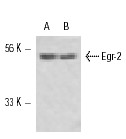
Western blot analysis of Egr-2 expression in Hep G2 (A) and LADMAC (B) nuclear extracts.| Product Name | Egr-2 Antibody (H-220) |
|---|---|
| Antibody Type | Primary Antibodies |
| Antigen Alias | epitope corresponding to amino acids 1-220 mapping at the N-terminus of Egr-2 of human origin |
| Modification Notes | Egr proteins function in transcription regulatory activities surrounding cellular growth, differentiation and function. The deduced amino acid sequences of human Egr-2 and mouse Egr-1 are 92% identical in the zinc finger region but show no homology elsewhere. Egr-2 is a sequence-specific DNA-binding transcription factor that binds two specific DNA sites located in the promoter region of HoxA4 and localizes to the nucleus. Defects in the Egr-2 protein are a cause of congenital hypomyelination neuropathy (CHN). CHN is characterized clinically by early onset of hypotonia, areflexia, distal muscle weakness and very slow nerve conduction velocities. Mutations in the gene that encodes Egr-2 (EGR2) also cause Dejerine-Sottas syndrome (DSS), which is also known as Dejerine-Sottas neuropathy (DSN) or hereditary motor and sensory neuropathy III (HMSN3). DSS patients exhibit severe early onset motor and sensory neuropathy with very slow nerve conduction velocities and elevated cerebrospinal fluid protein concentrations. |
| Clonality | Polyclonal |
|---|---|
| Isotype | IgG |
| Host Species | Rabbit |
| Tested Applications | WBIPIFELISAGSChIP |
| recommended for detection of Egr-2 of mouse, rat and human origin by WB, IP, IF and ELISA also reactive with additional species, including equine, canine and porcine: |
|
| Species Reactivity | HumanMouseRat |
| Concentration | 1mg/ml |
| Purification | Affinity purified |
| Alternative Names | epitope corresponding to amino acids 1-220 mapping at the N-terminus of Egr-2 of human origin |
|---|---|
| Tissue Specificity | epitope corresponding to amino acids 1-220 mapping at the N-terminus of Egr-2 of human origin |
| Entrez Gene | 1959 |
|---|
Application
Western blot analysis of Egr-2 expression in Hep G2 (A) and LADMAC (B) nuclear extracts.| Application Notes | recommended for detection of Egr-2 of mouse, rat and human origin by WB, IP, IF and ELISA also reactive with additional species, including equine, canine and porcine: |
|---|
| Form | Liquid |
|---|---|
| Storage Instructions | For short-term storage, store at 4° C. For long-term storage, aliquot and store at -20ºC or below. Avoid multiple freeze-thaw cycles. |
| Storage Buffer | phosphate buffered saline , pH 7.4, 150mM NaCl, 0.02% sodium azide and 50% glycerol. |


