Application
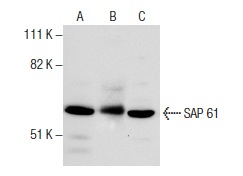
Western blot analysis of SAP 61 expression in HeLa (A), 293T (B) and Raji (C) whole cell lysates.| Product Name | SAP 61 Antibody (H-270) |
|---|---|
| Antibody Type | Primary Antibodies |
| Antigen Alias | epitope corresponding to amino acids 1-270 mapping at the N-terminus of SAP 61 of human origin |
| Modification Notes | SAP 61, also known as SF3A3 (splicing factor 3A subunit 3), PRP9, PRPF9 or SF3a60, is a 501 amino acid protein that contains one matrin-type zinc finger and belongs to the SF3A3 family. Localized to the nucleus, SAP 61 is a subunit of the SF3A splicing factor, a heterotrimeric complex comprised of three subunits that act in tandem to mediate the binding of U2 snRNP to the branchpoint sequence (BPS) in pre-mRNA. The SF3A complex is necessary for the conversion of 15S U2 snRNP into the active 17S protein that performs directly in pre-mRNA splicing events. Functioning as the third subunit of the complex, SAP 61 interacts with subunit 1 (SAP 114) via its N-terminus, while simultaneously binding to 15S U2 snRNP via its zinc finger domain. As is the case for all SF3A subunits, SAP 61 is essential for prespliceosome assembly and cell viability. In addition, a pseudogene exists for SAP 61 on chromosome 20. |
| Clonality | Polyclonal |
|---|---|
| Isotype | IgG |
| Host Species | Rabbit |
| Tested Applications | WBIPIFELISA |
| recommended for detection of SAP 61 of mouse, rat and human origin by WB, IP, IF and ELISA also reactive with additional species, including equine, canine, bovine, porcine and avian: |
|
| Species Reactivity | HumanMouseRat |
| Concentration | 1mg/ml |
| Purification | Affinity purified |
| Alternative Names | epitope corresponding to amino acids 1-270 mapping at the N-terminus of SAP 61 of human origin |
|---|---|
| Tissue Specificity | epitope corresponding to amino acids 1-270 mapping at the N-terminus of SAP 61 of human origin |
| Entrez Gene | 10946 |
|---|
Application
Western blot analysis of SAP 61 expression in HeLa (A), 293T (B) and Raji (C) whole cell lysates.| Application Notes | recommended for detection of SAP 61 of mouse, rat and human origin by WB, IP, IF and ELISA also reactive with additional species, including equine, canine, bovine, porcine and avian: |
|---|
| Form | Liquid |
|---|---|
| Storage Instructions | For short-term storage, store at 4° C. For long-term storage, aliquot and store at -20ºC or below. Avoid multiple freeze-thaw cycles. |
| Storage Buffer | phosphate buffered saline , pH 7.4, 150mM NaCl, 0.02% sodium azide and 50% glycerol. |


