Application
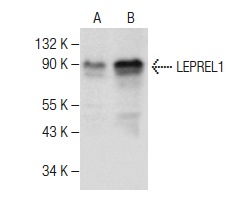
Western blot analysis of LEPREL1 expression in Hs 67 (A) and Caki-1 (B) whole cell lysates.| Product Name | LEPREL1 Antibody (H-126) |
|---|---|
| Antibody Type | Primary Antibodies |
| Antigen Alias | epitope corresponding to amino acids 317-442 mapping within an internal region of LEPREL1 of human origin |
| Modification Notes | LEPREL1 (leprecan-like 1), also known as P3H2 (Prolyl 3-hydroxylase 2 precursor) or MLAT4 (Myxoid liposarcoma-associated protein 4), is a 708 amino acid protein that belongs to a family of collagen prolyl hydroxylases. LEPREL1 has a highly conserved C-terminal domain that contains critical catalytic residues found in lysyl and prolyl 4-hydroxylases, including 2 iron-binding histidines and an aspartic acid. LEPREL1 is expressed in heart, placenta, lung, liver, skeletal muscle and kidney. Expression is localized to the epithelia of bile ducts and to the sarcoplasm of heart muscle and skeletal muscle. LEPREL1 is required for proper collagen biosynthesis, folding, and assembly. LEPREL1 forms a complex with cartilage-associated protein (CRTAP) and cyclophilin B (CyPB) in the endoplasmic reticulum. This complex is responsible for 3-hydroxylation of proline residues of collagen type I, II and V, and is important for normal bone development. |
| Clonality | Polyclonal |
|---|---|
| Isotype | IgG |
| Host Species | Rabbit |
| Tested Applications | WBIPIFELISA |
| recommended for detection of LEPREL1 of mouse, rat and human origin by WB, IP, IF and ELISA non cross-reactive with family member LEPREL2 also reactive with additional species, including equine, canine, bovine and porcine: |
|
| Species Reactivity | HumanMouseRat |
| Concentration | 1mg/ml |
| Purification | Affinity purified |
| Alternative Names | epitope corresponding to amino acids 317-442 mapping within an internal region of LEPREL1 of human origin |
|---|---|
| Tissue Specificity | epitope corresponding to amino acids 317-442 mapping within an internal region of LEPREL1 of human origin |
| Entrez Gene | 55214 |
|---|
Application
Western blot analysis of LEPREL1 expression in Hs 67 (A) and Caki-1 (B) whole cell lysates.| Application Notes | recommended for detection of LEPREL1 of mouse, rat and human origin by WB, IP, IF and ELISA non cross-reactive with family member LEPREL2 also reactive with additional species, including equine, canine, bovine and porcine: |
|---|
| Form | Liquid |
|---|---|
| Storage Instructions | For short-term storage, store at 4° C. For long-term storage, aliquot and store at -20ºC or below. Avoid multiple freeze-thaw cycles. |
| Storage Buffer | phosphate buffered saline , pH 7.4, 150mM NaCl, 0.02% sodium azide and 50% glycerol. |


