Application
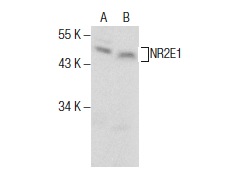
Western blot analysis of NR2E1 expression in Jurkat (A) and NIH/3T3 (B) nuclear extracts.| Product Name | NR2E1 Antibody (H-102) |
|---|---|
| Antibody Type | Primary Antibodies |
| Antigen Alias | epitope corresponding to amino acids 89-190 mapping within an internal region of NR2E1 of human origin |
| Modification Notes | NR2 proteins are a large family of nuclear hormone receptor transcription factors. The proteins belonging to this family are characterized by discrete domains functioning in DNA and ligand binding. NR2E1 (nuclear receptor subfamily 2, group E, member 1), also known as TLX, is an essential component in the formation of synaptic plasticity and dendritic structure in retinal astrocytes. In addition, NR2E1 is a orphan receptor that binds DNA as part of the hormone response element (HRE), a transcription regulator for hormones. DNA-binding orphan receptors have the conserved sequence 5'-AAGGTCA-3', a motif that determines substrate binding specificity. NR2E1 is expressed in brain tissue, with highest levels in astrocytes, and is localized to the nucleus. Mutations in the gene that encodes NR2E1 may lead to retinal dystrophy, a disorder characterized by a reduction in the thickness of the retina. |
| Clonality | Polyclonal |
|---|---|
| Isotype | IgG |
| Host Species | Rabbit |
| Tested Applications | WBIPIFELISA |
| recommended for detection of NR2E1 of mouse, rat and human origin by WB, IP, IF and ELISA also reactive with additional species, including equine, canine, bovine, porcine and avian: |
|
| Species Reactivity | HumanMouseRat |
| Concentration | 1mg/ml |
| Purification | Affinity purified |
| Alternative Names | epitope corresponding to amino acids 89-190 mapping within an internal region of NR2E1 of human origin |
|---|---|
| Tissue Specificity | epitope corresponding to amino acids 89-190 mapping within an internal region of NR2E1 of human origin |
| Entrez Gene | 7101 |
|---|
Application
Western blot analysis of NR2E1 expression in Jurkat (A) and NIH/3T3 (B) nuclear extracts.| Application Notes | recommended for detection of NR2E1 of mouse, rat and human origin by WB, IP, IF and ELISA also reactive with additional species, including equine, canine, bovine, porcine and avian: |
|---|
| Form | Liquid |
|---|---|
| Storage Instructions | For short-term storage, store at 4° C. For long-term storage, aliquot and store at -20ºC or below. Avoid multiple freeze-thaw cycles. |
| Storage Buffer | phosphate buffered saline , pH 7.4, 150mM NaCl, 0.02% sodium azide and 50% glycerol. |


