Application
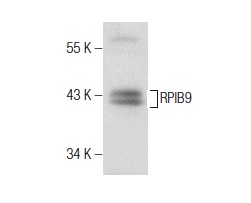
Western blot analysis of RPIB9 expression in MCF7 whole cell lysate.| Product Name | RPIB9 Antibody (H-135) |
|---|---|
| Antibody Type | Primary Antibodies |
| Antigen Alias | epitope corresponding to amino acids 301-435 mapping near the C-terminus of RPIB9 of human origin |
| Modification Notes | RPIB9 (Rap 2-interacting protein 9), also known as RUNDC3B (RUN domain containing 3B) or RPIP9, is a 473 amino acid protein that belongs to the RUNDC3 family and interacts with Rap 2. RPIB9 exists as four alternatively spliced isoforms and is encoded by a gene that maps to human chromosome 7q21.12. Chromosome 7 houses over 1,000 genes and comprises nearly 5% of the human genome. Chromosome 7 has been linked to Osteogenesis imperfecta, Pendred syndrome, Lissencephaly, Citrullinemia and Shwachman-Diamond syndrome. The deletion of a portion of the q arm of chromosome 7 is associated with Williams-Beuren syndrome, a condition characterized by mild mental retardation, an unusual comfort and friendliness with strangers and an elfin appearance. Deletions of portions of the q arm of chromosome 7 are also seen in a number of myeloid disorders including cases of acute myelogenous leukemia and myelodysplasia. |
| Clonality | Polyclonal |
|---|---|
| Isotype | IgG |
| Host Species | Rabbit |
| Tested Applications | WBIPIFELISA |
| recommended for detection of RPIB9 of human origin and Rundc3b of mouse and rat origin of mouse, rat and human origin by WB, IP, IF and ELISA also reactive with additional species, including equine, canine and porcine: |
|
| Species Reactivity | HumanMouseRat |
| Concentration | 1mg/ml |
| Purification | Affinity purified |
| Alternative Names | epitope corresponding to amino acids 301-435 mapping near the C-terminus of RPIB9 of human origin |
|---|---|
| Tissue Specificity | epitope corresponding to amino acids 301-435 mapping near the C-terminus of RPIB9 of human origin |
| Entrez Gene | 154661 |
|---|
Application
Western blot analysis of RPIB9 expression in MCF7 whole cell lysate.| Application Notes | recommended for detection of RPIB9 of human origin and Rundc3b of mouse and rat origin of mouse, rat and human origin by WB, IP, IF and ELISA also reactive with additional species, including equine, canine and porcine: |
|---|
| Form | Liquid |
|---|---|
| Storage Instructions | For short-term storage, store at 4° C. For long-term storage, aliquot and store at -20ºC or below. Avoid multiple freeze-thaw cycles. |
| Storage Buffer | phosphate buffered saline , pH 7.4, 150mM NaCl, 0.02% sodium azide and 50% glycerol. |


