Application
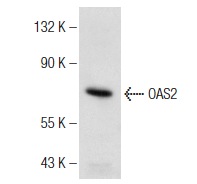
Western blot analysis of OAS2 expression in PC-12 whole cell lysate.| Product Name | OAS2 Antibody (R-130) |
|---|---|
| Antibody Type | Primary Antibodies |
| Antigen Alias | epitope corresponding to amino acids 101-230 mapping near the N-terminus of OAS2 of rat origin |
| Modification Notes | The 2'- 5'- oligoadenylate synthetase (OAS) family is comprised of four members: OAS1, OAS2, OAS3 and OASL. These proteins are induced by interferons and function to convert ATP into 2'- 5'- linked oligomers of adenosine in the presence of double-stranded RNA and magnesium ions. Copper, iron and zinc ions strongly inhibit the OAS enzymatic activity, while manganese ions can replace magnesium ions as an activator. The OAS family plays a significant role in the inhibition of cellular protein synthesis as well as in viral infection resistance. OAS2, which represents the “medium form” in the OAS family, maps to human chromosome 12q24. OAS2 contains two OAS1-homologous domains separated by a proline-rich putative linker region. It is functionally active as a dimer. Abnormal expression patterns of OAS2 may be linked to infection flare in Lupus patients. |
| Clonality | Polyclonal |
|---|---|
| Isotype | IgG |
| Host Species | Rabbit |
| Tested Applications | WBIPIFELISA |
| recommended for detection of OAS2 of rat origin by WB, IP, IF and ELISA: |
|
| Species Reactivity | HumanMouseRat |
| Concentration | 1mg/ml |
| Purification | Affinity purified |
| Alternative Names | epitope corresponding to amino acids 101-230 mapping near the N-terminus of OAS2 of rat origin |
|---|---|
| Tissue Specificity | epitope corresponding to amino acids 101-230 mapping near the N-terminus of OAS2 of rat origin |
Application
Western blot analysis of OAS2 expression in PC-12 whole cell lysate.| Application Notes | recommended for detection of OAS2 of rat origin by WB, IP, IF and ELISA: |
|---|
| Form | Liquid |
|---|---|
| Storage Instructions | For short-term storage, store at 4° C. For long-term storage, aliquot and store at -20ºC or below. Avoid multiple freeze-thaw cycles. |
| Storage Buffer | phosphate buffered saline , pH 7.4, 150mM NaCl, 0.02% sodium azide and 50% glycerol. |


