Application
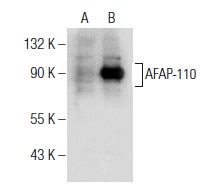
Western blot analysis of AFAP-110 expression in non-transfected: (A) and human AFAP-110 transfected: (B) 293T whole cell lysates.| Product Name | AFAP-110 Antibody (H-71) |
|---|---|
| Antibody Type | Primary Antibodies |
| Antigen Alias | epitope corresponding to amino acids 626-690 mapping near the C-terminus of AFAP-110 of human origin |
| Modification Notes | Actin filament associated protein (AFAP-110) interacts directly with Actin filaments through its C-terminal Actin binding domain. AFAP-110 contains additional protein-binding domains as well, and serves as an adaptor protein. AFAP-110 links signaling molecules to Actin filaments, provides a platform for the preparation of larger signaling complexes, activates Src kinases in response to cellular signals and also directly affects Actin organization as an Actin filament cross-linking protein. Deletion of certain binding elements of AFAP-110 results in altered Actin phenotypes; for instance, deletion of the leucine zipper motif causes repositioning of Actin into rosettes. Because inhibition of certain Actin cytoskeletal conformations inhibits cell division and movement, these conformational changes to AFAP-110, and thus Actin organization in the cell, represent a possible therapeutic target for controlling tumorigenesis and metastasis. |
| Clonality | Polyclonal |
|---|---|
| Isotype | IgG |
| Host Species | Rabbit |
| Tested Applications | WBIPIFELISA |
| recommended for detection of AFAP-110 of mouse, rat and human origin by WB, IP, IF and ELISA also reactive with additional species, including equine, canine, bovine, porcine and avian: |
|
| Species Reactivity | HumanMouseRat |
| Concentration | 1mg/ml |
| Purification | Affinity purified |
| Alternative Names | epitope corresponding to amino acids 626-690 mapping near the C-terminus of AFAP-110 of human origin |
|---|---|
| Tissue Specificity | epitope corresponding to amino acids 626-690 mapping near the C-terminus of AFAP-110 of human origin |
Application
Western blot analysis of AFAP-110 expression in non-transfected: (A) and human AFAP-110 transfected: (B) 293T whole cell lysates.| Application Notes | recommended for detection of AFAP-110 of mouse, rat and human origin by WB, IP, IF and ELISA also reactive with additional species, including equine, canine, bovine, porcine and avian: |
|---|
| Form | Liquid |
|---|---|
| Storage Instructions | For short-term storage, store at 4° C. For long-term storage, aliquot and store at -20ºC or below. Avoid multiple freeze-thaw cycles. |
| Storage Buffer | phosphate buffered saline , pH 7.4, 150mM NaCl, 0.02% sodium azide and 50% glycerol. |


