Application
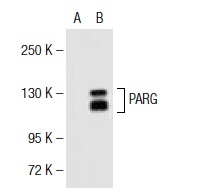
Western blot analysis of PARG expression in non-transfected (A) and human PARG transfected (B) 293 whole cell lysates.| Product Name | PARG Antibody (O-23) |
|---|---|
| Antibody Type | Primary Antibodies |
| Antigen Alias | recommended for detection of PARG of human origin by WB, IF, IHC(P) and ELISA |
| Modification Notes | The synthesis and rapid turnover of ADP-ribose polymers is an immediate cellular response to DNA damage. Poly (ADP-ribose) is a reversible covalent-modifier to chromosomal proteins and is synthesized by poly (ADP-ribose) polymerase (PARP-1) and other related enzymes. Poly (ADP-ribose) glycohydrolase (PARG) is the enzyme responsible for polymer turnover. Under normal growth conditions, PARG localizes to the cytoplasm. PARG is an enzymatically active protein that is cleaved to multiple fragments. PARG is cleaved during etoposide-, staurosporine-, and Fas-induced apoptosis in human cells by caspases, and generates two C-terminal fragments, which still contain the active site of the enzyme required to hydrolyze poly (ADP-ribose). Under normal growth, PARG is expressed only as a doublet by SDS-PAGE. The gene encoding PARG maps to human chromosome 10q11.23. |
| Clonality | Polyclonal |
|---|---|
| Isotype | IgG |
| Host Species | Rabbit |
| Tested Applications | WBIFIHCELISA |
| WB:1:500~1:2000 IF:1:200~1:500 IHC:1:50~1:200 Notes:Optimal dilutions/concentrations should be determined by the researcher. |
|
| Species Reactivity | HumanMouseRat |
| Concentration | 1mg/ml |
| Purification | Affinity purified |
| Alternative Names | recommended for detection of PARG of human origin by WB IF IHC(P) and ELISA |
|---|---|
| Tissue Specificity | recommended for detection of PARG of human origin by WB, IF, IHC(P) and ELISA |
| Entrez Gene | 8505 |
|---|
Application
Western blot analysis of PARG expression in non-transfected (A) and human PARG transfected (B) 293 whole cell lysates.| Application Notes | WB:1:500~1:2000 IF:1:200~1:500 IHC:1:50~1:200 Notes:Optimal dilutions/concentrations should be determined by the researcher. |
|---|
| Form | Liquid |
|---|---|
| Storage Instructions | For short-term storage, store at 4° C. For long-term storage, aliquot and store at -20ºC or below. Avoid multiple freeze-thaw cycles. |
| Storage Buffer | phosphate buffered saline , pH 7.4, 150mM NaCl, 0.02% sodium azide and 50% glycerol. |


