Application
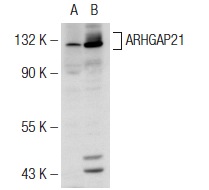
Western blot analysis of ARHGAP21 expression in T98G (A) and Jurkat (B) whole cell lysates.| Product Name | ARHGAP21 Antibody (H-300) |
|---|---|
| Antibody Type | Primary Antibodies |
| Antigen Alias | epitope corresponding to amino acids 241-540 mapping within an internal region of ARHGAP21 of human origin |
| Modification Notes | GTPase-activating proteins (GAPs) accelerate the intrinsic rate of GTP hydrolysis of Ras-related proteins, resulting in downregulation of their active form. ARHGAP21 (Rho GTPase activating protein 21), also known as ARHGAP10, is a 1,957 amino acid protein that localizes to the membrane of the golgi apparatus, as well as to cell junctions and the cytoplasm, and contains one Rho-GAP domain, one PH domain and one PDZ domain. Expressed at high levels in heart, placenta, brain and skeletal muscle, ARHGAP21 functions as a GTPase-activating protein for Cdc42 and Rho A and is thought to control the structure and activity of the golgi apparatus. While ARHGAP21 is upregulated during cellular differentiation, depletion of ARHGAP21 may induce cell spreading, as well as an accumulation of Actin stress fibers. Multiple isoforms of ARHGAP21 exist due to alternative splicing events. |
| Clonality | Polyclonal |
|---|---|
| Isotype | IgG |
| Host Species | Rabbit |
| Tested Applications | WBIPIFELISA |
| recommended for detection of ARHGAP21 of mouse, rat and human origin by WB, IP, IF and ELISA also reactive with additional species, including equine, canine, bovine and porcine: |
|
| Species Reactivity | HumanMouseRat |
| Concentration | 1mg/ml |
| Purification | Affinity purified |
| Alternative Names | epitope corresponding to amino acids 241-540 mapping within an internal region of ARHGAP21 of human origin |
|---|---|
| Tissue Specificity | epitope corresponding to amino acids 241-540 mapping within an internal region of ARHGAP21 of human origin |
| Entrez Gene | 57584 |
|---|
Application
Western blot analysis of ARHGAP21 expression in T98G (A) and Jurkat (B) whole cell lysates.| Application Notes | recommended for detection of ARHGAP21 of mouse, rat and human origin by WB, IP, IF and ELISA also reactive with additional species, including equine, canine, bovine and porcine: |
|---|
| Form | Liquid |
|---|---|
| Storage Instructions | For short-term storage, store at 4° C. For long-term storage, aliquot and store at -20ºC or below. Avoid multiple freeze-thaw cycles. |
| Storage Buffer | phosphate buffered saline , pH 7.4, 150mM NaCl, 0.02% sodium azide and 50% glycerol. |


