Application
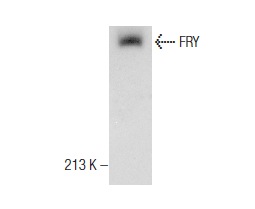
Western blot analysis of FRY expression in human kidney tissue extract.| Product Name | FRY Antibody (N-19) |
|---|---|
| Antibody Type | Primary Antibodies |
| Antigen Alias | epitope mapping near the N-terminus of FRY of human origin |
| Modification Notes | In yeast, flies, and worms, the Dbf2-related (Ndr) kinase protein family functions in various aspects of cell polarity and morphogenesis. The Drosophila melanogaster protein, furry, is responsible for maintaining integrity of polarized cell extensions, such as epidermal hair cells, lateral extensions of the arista and the shafts of neuronal sensory bristles. Mutations in furry lead to the formation of branched arista laterals, bristles and hairs. The yeast homolog of furry, Mor2, is important for the localization of F-actin specifically at the cell ends and is required for the restriction of the growth zones. The mammalian homolog of the Drosophila furry protein is FRY, also known as C13orf14, a 3,013 amino acid protein that probably functions as a transcription factor for genes that regulate the actin cytoskeleton. The gene encoding FRY maps to chromosome 13, which comprises nearly 4% of human DNA and contains around 114 million base pairs and 400 genes. |
| Clonality | Polyclonal |
|---|---|
| Isotype | IgG |
| Host Species | Rabbit |
| Tested Applications | WBIPIFELISA |
| recommended for detection of FRY of mouse and human origin by WB, IP, IF and ELISA also reactive with additional species, including equine, canine, bovine and porcine: |
|
| Species Reactivity | HumanMouseRat |
| Concentration | 1mg/ml |
| Purification | Affinity purified |
| Alternative Names | epitope mapping near the N-terminus of FRY of human origin |
|---|---|
| Tissue Specificity | epitope mapping near the N-terminus of FRY of human origin |
| Entrez Gene | 10129 |
|---|
Application
Western blot analysis of FRY expression in human kidney tissue extract.| Application Notes | recommended for detection of FRY of mouse and human origin by WB, IP, IF and ELISA also reactive with additional species, including equine, canine, bovine and porcine: |
|---|
| Form | Liquid |
|---|---|
| Storage Instructions | For short-term storage, store at 4° C. For long-term storage, aliquot and store at -20ºC or below. Avoid multiple freeze-thaw cycles. |
| Storage Buffer | phosphate buffered saline , pH 7.4, 150mM NaCl, 0.02% sodium azide and 50% glycerol. |


