Application
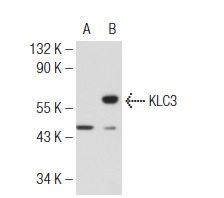
Western blot analysis of KLC3 expression in non-transfected: (A) and mouse KLC3 transfected: (B) 293T whole cell lysates.Application
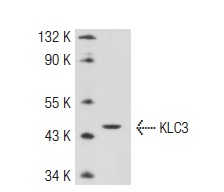
Western blot analysis of KLC3 expression in Jurkat whole cell lysate.| Product Name | KLC3 Antibody (K-21) |
|---|---|
| Antibody Type | Primary Antibodies |
| Antigen Alias | recommended for detection of KLC3 of mouse, rat and human origin by WB, IP and ELISA |
| Modification Notes | The kinesins constitute a large family of microtubule-dependent motor proteins which are responsible for the distribution of numerous organelles, vesicles and macromolecular complexes throughout the cell. Individual kinesin members play crucial roles in cell division, intracellular transport and membrane trafficking events, including endocytosis and transcytosis. KLC3 (kinesin light chain 3), also known as KLC2 or KLC2L, is a 504 amino acid protein that contains five TPR repeats and belongs to the kinesin light chain family. Existing as a component of an oligomeric composed of heavy and light chains, KLC3 functions as a microtubule-associated protein that produces mechanical force and is thought to play a role in organelle transport. Multiple isoforms of KLC3 exist due to alternative splicing events. |
| Clonality | Polyclonal |
|---|---|
| Isotype | IgG |
| Host Species | Rabbit |
| Tested Applications | WBIPELISA |
| WB:1:500~1:2000 IP:1:100~1:500 Notes:Optimal dilutions/concentrations should be determined by the researcher. |
|
| Species Reactivity | HumanMouseRat |
| Concentration | 1mg/ml |
| Purification | Affinity purified |
| Alternative Names | recommended for detection of KLC3 of mouse rat and human origin by WB IP and ELISA |
|---|---|
| Tissue Specificity | recommended for detection of KLC3 of mouse, rat and human origin by WB, IP and ELISA |
| Entrez Gene | 147700 |
|---|
Application
Western blot analysis of KLC3 expression in non-transfected: (A) and mouse KLC3 transfected: (B) 293T whole cell lysates.
Application
Western blot analysis of KLC3 expression in Jurkat whole cell lysate.| Application Notes | WB:1:500~1:2000 IP:1:100~1:500 Notes:Optimal dilutions/concentrations should be determined by the researcher. |
|---|
| Form | Liquid |
|---|---|
| Storage Instructions | For short-term storage, store at 4° C. For long-term storage, aliquot and store at -20ºC or below. Avoid multiple freeze-thaw cycles. |
| Storage Buffer | phosphate buffered saline , pH 7.4, 150mM NaCl, 0.02% sodium azide and 50% glycerol. |


