Application
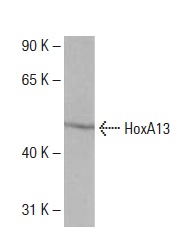
Western blot analysis of HoxA13 expression in human fetal liver tissue extract.| Product Name | HoxA13 Antibody (Z-24) |
|---|---|
| Antibody Type | Primary Antibodies |
| Antigen Alias | recommended for detection of HoxA13 of human origin by WB, IP, IF, IHC(P) and ELISA |
| Modification Notes | The Hox proteins play a role in development and cellular differentiation by regulating downstream target genes. Specifically, the Hox proteins direct DNA-protein and protein-protein interactions that assist in determining the morphologic features associated with the anterior-posterior body axis. HoxA13 and HoxD13 also bind to other BMP and TGF-beta/Activin-regulated Smad proteins including Smad1 and Smad2, but not Smad4. In humans and mice, loss of HOXA13 function causes defects in the growth and patterning of the digits and interdigital tissues. Analysis of HoxA13 expression reveals a pattern of localization overlapping with sites of reduced Bmp2 and Bmp7 expression in HoxA13 mutant limbs. HoxA13 regulates Bmp2 and Bmp7 expression, providing a link between HoxA13, its target genes and the specific developmental processes affected by loss of HoxA13 function. |
| Clonality | Polyclonal |
|---|---|
| Isotype | IgG |
| Host Species | Rabbit |
| Tested Applications | WBIPIFIHCELISA |
| WB:1:500~1:2000 IP:1:100~1:500 IF:1:200~1:500 IHC:1:50~1:200 Notes:Optimal dilutions/concentrations should be determined by the researcher. |
|
| Species Reactivity | HumanMouseRat |
| Concentration | 1mg/ml |
| Purification | Affinity purified |
| Alternative Names | recommended for detection of HoxA13 of human origin by WB IP IF IHC(P) and ELISA |
|---|---|
| Tissue Specificity | recommended for detection of HoxA13 of human origin by WB, IP, IF, IHC(P) and ELISA |
| Entrez Gene | 3209 |
|---|
Application
Western blot analysis of HoxA13 expression in human fetal liver tissue extract.| Application Notes | WB:1:500~1:2000 IP:1:100~1:500 IF:1:200~1:500 IHC:1:50~1:200 Notes:Optimal dilutions/concentrations should be determined by the researcher. |
|---|
| Form | Liquid |
|---|---|
| Storage Instructions | For short-term storage, store at 4° C. For long-term storage, aliquot and store at -20ºC or below. Avoid multiple freeze-thaw cycles. |
| Storage Buffer | phosphate buffered saline , pH 7.4, 150mM NaCl, 0.02% sodium azide and 50% glycerol. |


