Application
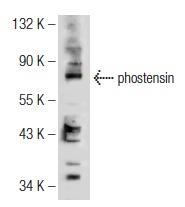
Western blot analysis of phostensin expression in MIA PaCa-2 whole cell lysate.Application
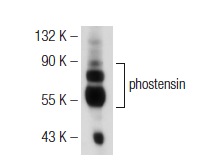
Western blot analysis of phostensin expression in mouse lung tissue extract.| Product Name | phostensin Antibody (M-300) |
|---|---|
| Antibody Type | Primary Antibodies |
| Antigen Alias | epitope corresponding to amino acids 121-420 mapping within an internal region of phostensin of mouse origin |
| Modification Notes | In eukaryotes, the phosphorylation and dephosphorylation of proteins on serine and threonine residues is an essential means of regulating a broad range of cellular functions, including division, homeostasis and apoptosis. A group of proteins that are intimately involved in this process are the protein phosphatases, specifically PP1 (protein phosphhatase 1), which is targeted to different substrates throughout the cell. Phostensin, also known as KIAA1949, is a 613 amino acid protein that localizes to both the cytoplasm and the cytoskeleton. Expressed predominately in spleen, ovary, lung and liver tissue, phostensin functions as a regulatory subunit that interacts with and targets PP1 to F-Actin in the cytoskeleton. Two isoforms of phostensin exist due to alternative splicing events. |
| Clonality | Polyclonal |
|---|---|
| Isotype | IgG |
| Host Species | Rabbit |
| Tested Applications | WBIPIFELISA |
| recommended for detection of phostensin of mouse, rat and, to a lesser extent, human origin by WB, IP, IF and ELISA: |
|
| Species Reactivity | HumanMouseRat |
| Concentration | 1mg/ml |
| Purification | Affinity purified |
| Alternative Names | epitope corresponding to amino acids 121-420 mapping within an internal region of phostensin of mouse origin |
|---|---|
| Tissue Specificity | epitope corresponding to amino acids 121-420 mapping within an internal region of phostensin of mouse origin |
Application
Western blot analysis of phostensin expression in MIA PaCa-2 whole cell lysate.
Application
Western blot analysis of phostensin expression in mouse lung tissue extract.| Application Notes | recommended for detection of phostensin of mouse, rat and, to a lesser extent, human origin by WB, IP, IF and ELISA: |
|---|
| Form | Liquid |
|---|---|
| Storage Instructions | For short-term storage, store at 4° C. For long-term storage, aliquot and store at -20ºC or below. Avoid multiple freeze-thaw cycles. |
| Storage Buffer | phosphate buffered saline , pH 7.4, 150mM NaCl, 0.02% sodium azide and 50% glycerol. |


