Application
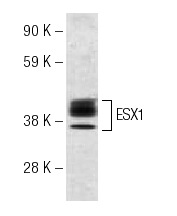
Western blot analysis of ESX1 expression in mouse testis tissue extract.| Product Name | ESX1 Antibody (A-21) |
|---|---|
| Antibody Type | Primary Antibodies |
| Antigen Alias | recommended for detection of ESX1 of mouse origin by WB, IP and ELISA |
| Modification Notes | ESX1 was originally identified as a regulator of mouse embryogenesis. In mice, it is primarily expressed in placenta and testis where it functions in placenta/fetus development and spermatogenesis, respectively. In human cell lines, ESX1 has been elucidated as a paired-like homeoprotein that is proteolytically processed into N-terminal and C-terminal fragments. The N-terminal ESX1 fragment, which contains the homeodomain, localizes to the nucleus and represses mRNA transcription from the K-ras gene. A gain-of-function mutation of the K-ras gene is one of the most common genetic changes in human tumors. Therefore, ESX1 is implicated as a therapeutic target in the treatment of human cancers that have oncogenic K-ras mutations. |
| Clonality | Polyclonal |
|---|---|
| Isotype | IgG |
| Host Species | Rabbit |
| Tested Applications | WBIPELISA |
| WB:1:500~1:2000 IP:1:100~1:500 Notes:Optimal dilutions/concentrations should be determined by the researcher. |
|
| Species Reactivity | HumanMouseRat |
| Concentration | 1mg/ml |
| Purification | Affinity purified |
| Alternative Names | recommended for detection of ESX1 of mouse origin by WB IP and ELISA |
|---|---|
| Tissue Specificity | recommended for detection of ESX1 of mouse origin by WB, IP and ELISA |
| Entrez Gene | 13984 |
|---|
Application
Western blot analysis of ESX1 expression in mouse testis tissue extract.| Application Notes | WB:1:500~1:2000 IP:1:100~1:500 Notes:Optimal dilutions/concentrations should be determined by the researcher. |
|---|
| Form | Liquid |
|---|---|
| Storage Instructions | For short-term storage, store at 4° C. For long-term storage, aliquot and store at -20ºC or below. Avoid multiple freeze-thaw cycles. |
| Storage Buffer | phosphate buffered saline , pH 7.4, 150mM NaCl, 0.02% sodium azide and 50% glycerol. |


