Application
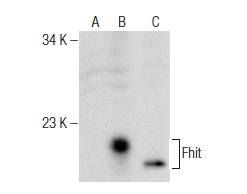
Western blot analysis of Fhit expression in non-transfected: (A) and human Fhit transfected: (B) 293T whole cell lysates and human kidney tissue extract (C).| Product Name | Fhit Antibody (H-107) |
|---|---|
| Antibody Type | Primary Antibodies |
| Antigen Alias | epitope corresponding to amino acids 1-107 mapping at the N-terminus of Fhit of human origin |
| Modification Notes | FHIT, a candidate tumor suppressor gene, contains the FRA3B common fragile site and is highly susceptible to carcinogen damage. The pattern of mutational inactivation seen with the FHIT gene is unique compared with other known tumor suppressors. FHIT gene structure and expression have been shown to be altered in esophageal, head, neck, lung, gastric, breast, and cervical carcinomas. It has been demonstrated that FHIT exon loss is associated with smoking duration or asbestos exposure. The FHIT protein is a member of the histidine triad (HIT) superfamily and functions as a dinucleoside 5’,5’’’-P1,P3-triphosphate hydrolase. |
| Clonality | Polyclonal |
|---|---|
| Isotype | IgG |
| Host Species | Rabbit |
| Tested Applications | WBIPIFELISA |
| recommended for detection of Fhit of mouse, rat and human origin by WB, IP, IF and ELISA also reactive with additional species, including equine, canine, bovine and porcine: |
|
| Species Reactivity | HumanMouseRat |
| Concentration | 1mg/ml |
| Purification | Affinity purified |
| Alternative Names | epitope corresponding to amino acids 1-107 mapping at the N-terminus of Fhit of human origin |
|---|---|
| Tissue Specificity | epitope corresponding to amino acids 1-107 mapping at the N-terminus of Fhit of human origin |
| Entrez Gene | 2272 |
|---|
Application
Western blot analysis of Fhit expression in non-transfected: (A) and human Fhit transfected: (B) 293T whole cell lysates and human kidney tissue extract (C).| Application Notes | recommended for detection of Fhit of mouse, rat and human origin by WB, IP, IF and ELISA also reactive with additional species, including equine, canine, bovine and porcine: |
|---|
| Form | Liquid |
|---|---|
| Storage Instructions | For short-term storage, store at 4° C. For long-term storage, aliquot and store at -20ºC or below. Avoid multiple freeze-thaw cycles. |
| Storage Buffer | phosphate buffered saline , pH 7.4, 150mM NaCl, 0.02% sodium azide and 50% glycerol. |


