Application
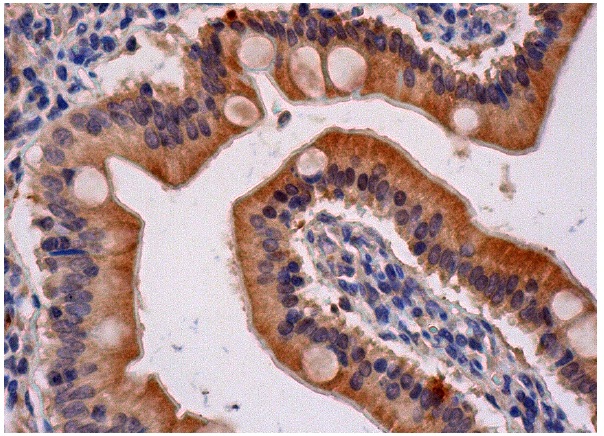
Immunoperoxidase staining of formalin fixed, paraffin-embedded human duodenum tissue showing cytoplasmic staining of glandular cells.| Product Name | STRAD Antibody (H-83) |
|---|---|
| Antibody Type | Primary Antibodies |
| Antigen Alias | epitope corresponding to amino acids 47-129 mapping near the N-terminus of STRAD of human origin |
| Modification Notes | Peutz-Jegers Syndrome (PJS) is a rare hereditary disease characterized by melanocytic macules of the lips, gastrointestinal hamartomatous polyps and an increased risk for many classes of cancer. The serine/threonine kinase LKB1 (also designated STK11) has been identified as the gene mutated in PJS. LKB1 activity increases upon the binding of a regulatory complex consisting of the STE20-related adaptor-alpha (STRAD alpha) pseudo kinase and the calcium binding protein 39 (MO25 alpha). STRAD determines the subcellular localization of LKB1 by initiating its translocation from the nucleus to the cytoplasm, thus regulating the tumor suppressor activity of LKB1. |
| Clonality | Polyclonal |
|---|---|
| Isotype | IgG |
| Host Species | Rabbit |
| Tested Applications | WBIPIFIHCELISA |
| recommended for detection of STRAD of mouse, rat and human origin by WB, IP, IF, IHC(P) and ELISA also reactive with additional species, including canine, bovine and porcine: |
|
| Species Reactivity | HumanMouseRat |
| Concentration | 1mg/ml |
| Purification | Affinity purified |
| Alternative Names | epitope corresponding to amino acids 47-129 mapping near the N-terminus of STRAD of human origin |
|---|---|
| Tissue Specificity | epitope corresponding to amino acids 47-129 mapping near the N-terminus of STRAD of human origin |
| Entrez Gene | 92335 |
|---|
Application
Immunoperoxidase staining of formalin fixed, paraffin-embedded human duodenum tissue showing cytoplasmic staining of glandular cells.| Application Notes | recommended for detection of STRAD of mouse, rat and human origin by WB, IP, IF, IHC(P) and ELISA also reactive with additional species, including canine, bovine and porcine: |
|---|
| Form | Liquid |
|---|---|
| Storage Instructions | For short-term storage, store at 4° C. For long-term storage, aliquot and store at -20ºC or below. Avoid multiple freeze-thaw cycles. |
| Storage Buffer | phosphate buffered saline , pH 7.4, 150mM NaCl, 0.02% sodium azide and 50% glycerol. |


