Application
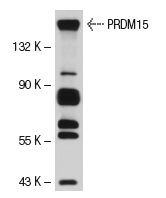
Western blot analysis of PRDM15 expression in mouse brain tissue extract.| Product Name | PRDM15 Antibody (L-17) |
|---|---|
| Antibody Type | Primary Antibodies |
| Antigen Alias | epitope mapping near the C-terminus of PRDM15 of human origin |
| Modification Notes | The PR-domain containing proteins (PRDMs) have a common involvement in the modulation of gene activities. A PR-domain family member usually produces two products, called PR-plus and PR-minus, which differ by the presence or absence of the PR domain, respectively. The PR-plus product is underexpressed or disrupted in cancer cells, whereas the PR-minus product is present or overexpressed in cancer cells. This imbalance in the amount of the two products, which is a result of either genetic or epigenetic events, appears to be a determining factor of malignancy. PRDM15 (PR domain-containing protein 15), also known as PFM15 or ZNF298, is a 1507 amino acid protein belonging to the PRDM family. Localizing to the nucleus, PRDM15 contains sixteen C2H2-type zinc fingers and one SET domain. It is believed to participate in transcriptional regulation and may be involved in cell differentiation and tumorigenesis. |
| Clonality | Polyclonal |
|---|---|
| Isotype | IgG |
| Host Species | Rabbit |
| Tested Applications | WBIPIFELISA |
| recommended for detection of PRDM15 of mouse, rat and human origin by WB, IP, IF and ELISA non cross-reactive with other PRDM family members also reactive with additional species, including canine, bovine and porcine: |
|
| Species Reactivity | HumanMouseRat |
| Concentration | 1mg/ml |
| Purification | Affinity purified |
| Alternative Names | epitope mapping near the C-terminus of PRDM15 of human origin |
|---|---|
| Tissue Specificity | epitope mapping near the C-terminus of PRDM15 of human origin |
| Entrez Gene | 63977 |
|---|
Application
Western blot analysis of PRDM15 expression in mouse brain tissue extract.| Application Notes | recommended for detection of PRDM15 of mouse, rat and human origin by WB, IP, IF and ELISA non cross-reactive with other PRDM family members also reactive with additional species, including canine, bovine and porcine: |
|---|
| Form | Liquid |
|---|---|
| Storage Instructions | For short-term storage, store at 4° C. For long-term storage, aliquot and store at -20ºC or below. Avoid multiple freeze-thaw cycles. |
| Storage Buffer | phosphate buffered saline , pH 7.4, 150mM NaCl, 0.02% sodium azide and 50% glycerol. |


