Application
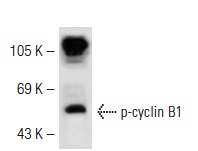
Western blot analysis of cyclin B1 phosphorylation in K-562 whole cell lysate.| Product Name | p-cyclin B1 Antibody (Ser 128) |
|---|---|
| Antibody Type | Primary Antibodies |
| Antigen Alias | recommended for detection of Ser 128 phosphorylated cyclin B1 of human origin by WB, IP and ELISA |
| Modification | Phosphoralated |
| Modification Notes | During interphase, cyclin B1 shuttles between the nucleus and the cytoplasm (1–3). At M phase, cyclin B1 is phosphorylated in the cytoplasmic retention sequence, which is required for nuclear export (1–3). Phosphorylation enhances cyclin B1 nuclear import by creating a nuclear import signal, indicating that phosphorylation of human cyclin B1 is required for its rapid translocation to the nucleus towards the end of prophase and is, therefore, a critical step in the control of mitosis (1,2). Phosphorylation of Ser 133 and Ser 147 is necessary for the nuclear translocation of cyclin B1 during prophase, and phosphorylation of Ser 126 and Ser 128 may stimulate the nuclear translocation (4). Plk1 (polo-like kinase) may phosphorylate Ser 133 and/or Ser 147 of cyclin B1 in the G2/M transition of mammalian cells (5). The direct phosphorylation of cyclin B1 on Ser 147 by Plk1 during prophase is central to inducing nuclear translocation of cyclin B1 (4). Plk1 protein is low in G1, accumulates during S and G2M, and is rapidly reduced after mitosis. (5). |
| Clonality | Polyclonal |
|---|---|
| Isotype | IgG |
| Host Species | Rabbit |
| Tested Applications | WBIPELISA |
| WB:1:500~1:2000 IP:1:100~1:500 Notes:Optimal dilutions/concentrations should be determined by the researcher. |
|
| Species Reactivity | HumanMouseRat |
| Concentration | 1mg/ml |
| Purification | Affinity purified |
| Alternative Names | recommended for detection of Ser 128 phosphorylated cyclin B1 of human origin by WB IP and ELISA |
|---|---|
| Tissue Specificity | recommended for detection of Ser 128 phosphorylated cyclin B1 of human origin by WB, IP and ELISA |
| Entrez Gene | 891 |
|---|
Application
Western blot analysis of cyclin B1 phosphorylation in K-562 whole cell lysate.| Application Notes | WB:1:500~1:2000 IP:1:100~1:500 Notes:Optimal dilutions/concentrations should be determined by the researcher. |
|---|
| Form | Liquid |
|---|---|
| Storage Instructions | For short-term storage, store at 4° C. For long-term storage, aliquot and store at -20ºC or below. Avoid multiple freeze-thaw cycles. |
| Storage Buffer | phosphate buffered saline , pH 7.4, 150mM NaCl, 0.02% sodium azide and 50% glycerol. |


