Application
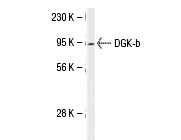
Western blot analysis of DGK-b expression in mouse liver tissue extract.| Product Name | DGK-β Antibody (C-24) |
|---|---|
| Antibody Type | Primary Antibodies |
| Antigen Alias | recommended for detection of DGK-β of mouse and human origin by WB, IP, IF, IHC(P) and ELISA |
| Modification Notes | Diacylglycerol kinases (DGKs) phosphorylate diacylglycerol (DAG) to produce phosphatidic acid. DAG and phosphatidic acid are lipids that act as second messengers in signaling cascades. DGK-alpha influences cell activation and secretion of lethal exosomes, which in turn control cell death. DGK-beta is abundant in restricted brain regions such as the caudate putamen and olfactory tubercle. DGK-gamma encodes full-length and truncated transcripts that are present in a range of human tissues, with greatest expression observed in retina. DGK-delta is most abundant in skeletal muscle. DGK-epsilon shows specificity for arachidonyl-containing diacylglycerol and is expressed predominantly in testis. DGK-theta is most abundant in the cerebellum and hippocampus. DGK-iota is present in brain and retina as a predominant transcript of more than 12 kb, including a long 3-prime untranslated region, with additional low abundance transcripts of 9.5 and 7.5 kb. DGK-eta is closely related to DGK-delta. DGK-zeta is most abundant in brain and muscle. DGKs have structural motifs that play regulatory roles, and these motifs form the basis for dividing the DGKs into five subtypes. |
| Clonality | Polyclonal |
|---|---|
| Isotype | IgG |
| Host Species | Rabbit |
| Tested Applications | WBIPIFIHCELISA |
| WB:1:500~1:2000 IP:1:100~1:500 IF:1:200~1:500 IHC:1:50~1:200 Notes:Optimal dilutions/concentrations should be determined by the researcher. |
|
| Species Reactivity | HumanMouseRat |
| Concentration | 1mg/ml |
| Purification | Affinity purified |
| Alternative Names | recommended for detection of DGK-&beta of mouse and human origin by WB IP IF IHC(P) and ELISA |
|---|---|
| Tissue Specificity | recommended for detection of DGK-β of mouse and human origin by WB, IP, IF, IHC(P) and ELISA |
| Entrez Gene | 1607 |
|---|
Application
Western blot analysis of DGK-b expression in mouse liver tissue extract.| Application Notes | WB:1:500~1:2000 IP:1:100~1:500 IF:1:200~1:500 IHC:1:50~1:200 Notes:Optimal dilutions/concentrations should be determined by the researcher. |
|---|
| Form | Liquid |
|---|---|
| Storage Instructions | For short-term storage, store at 4° C. For long-term storage, aliquot and store at -20ºC or below. Avoid multiple freeze-thaw cycles. |
| Storage Buffer | phosphate buffered saline , pH 7.4, 150mM NaCl, 0.02% sodium azide and 50% glycerol. |


