Application
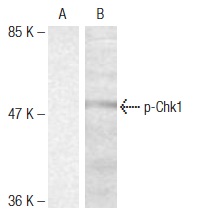
Western blot analysis of phosphorylated Chk1 expression in untreated (A) and UV-treated (B) HL-60 cell extracts.| Product Name | p-Chk1 Antibody (Ser 280) |
|---|---|
| Antibody Type | Primary Antibodies |
| Antigen Alias | recommended for detection of Ser 280 phosphorylated Chk1 of human origin by WB and IP |
| Modification | Phosphoralated |
| Modification Notes | Cell cycle events are regulated by the sequential activation and deactivation of cyclin dependent kinases (Cdks) and by proteolysis of cyclins (1). Chk1 and Chk2 are involved in these processes as regulators of Cdks. Chk1 and Chk2 both function as essential components in the G2 DNA damage checkpoint by phospho-rylating Cdc25C in response to DNA damage. Phosphorylation inhibits Cdc25C activity, thereby blocking mitosis (2–5). Cdc25A, Cdc25B and Cdc25C protein tyrosine phosphatases function as mitotic activators by dephosphorylating Cdc2 p34 on regulatory tyrosine residues (6). It has also been shown that Chk1 can phosphorylate Wee1 in vitro, providing evidence that the hyperphosphorylated form of Wee1, seen in cells delayed by Chk1 overexpression, is due to phosphorylation by Chk1 (3). Chk1 is phosphorylated on Serine 345 (S345) in response to UV, IR and hydroxyurea (HU) (7). Chk1 plays an essential role in the mammalian DNA damage checkpoint, embryonic development, and tumor suppression (7). The phosphorylation of human Chk1 on Ser 280 is thought to be promoted by Akt1 and may lead to mono and/or diubiquitination of Chk1. |
| Clonality | Polyclonal |
|---|---|
| Isotype | IgG |
| Host Species | Rabbit |
| Tested Applications | WBIP |
| WB:1:500~1:2000 IP:1:100~1:500 Notes:Optimal dilutions/concentrations should be determined by the researcher. |
|
| Species Reactivity | HumanMouseRat |
| Concentration | 1mg/ml |
| Purification | Affinity purified |
| Alternative Names | recommended for detection of Ser 280 phosphorylated Chk1 of human origin by WB and IP |
|---|---|
| Tissue Specificity | recommended for detection of Ser 280 phosphorylated Chk1 of human origin by WB and IP |
| Entrez Gene | 1111 |
|---|
Application
Western blot analysis of phosphorylated Chk1 expression in untreated (A) and UV-treated (B) HL-60 cell extracts.| Application Notes | WB:1:500~1:2000 IP:1:100~1:500 Notes:Optimal dilutions/concentrations should be determined by the researcher. |
|---|
| Form | Liquid |
|---|---|
| Storage Instructions | For short-term storage, store at 4° C. For long-term storage, aliquot and store at -20ºC or below. Avoid multiple freeze-thaw cycles. |
| Storage Buffer | phosphate buffered saline , pH 7.4, 150mM NaCl, 0.02% sodium azide and 50% glycerol. |


