Application
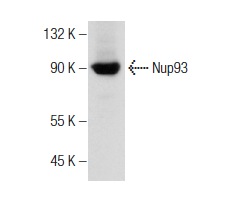
Western blot analysis of Nup93 expression in F9 whole cell lysate.| Product Name | Nup93 Antibody (H-300) |
|---|---|
| Antibody Type | Primary Antibodies |
| Antigen Alias | epitope corresponding to amino acids 1-300 mapping at the N-terminus of Nup93 of human origin |
| Modification Notes | The nuclear pore complex (NPC) mediates bidirectional macromolecular traffic between the nucleus and cytoplasm in eukaryotic cells and is comprised of more than 100 different subunits. Many of the subunits belong to a family called nucleoporins (Nups), which are characterized by the presence of O-linked-N-acetylglucosamine moieties and a distinctive pentapeptide repeat (XFXFG). Nup93 (nucleoporin 93) is the most abundant nucleoporin found per NPC, contributing over 10% of the mass. It localizes to the nuclear side of the NPC, predominantly in the basket terminal ring area, and exists in a complex with Nup188, Nup53 and Nup205. This complex is crucial for NPC stability and proper assembly. Nup93 interacts directly with the Nup62 complex located at the center of the NPC and thus tethers the two subcomplexes. Nup93 is composed of a coiled-coil domain at its N-terminus and a C-terminal helical domain. Its proper function is essential for cell viability and normal NPC function. |
| Clonality | Polyclonal |
|---|---|
| Isotype | IgG |
| Host Species | Rabbit |
| Tested Applications | WBIPIFELISA |
| recommended for detection of Nup93 of mouse, rat and human origin by WB, IP, IF and ELISA also reactive with additional species, including equine, canine, bovine, porcine and avian: |
|
| Species Reactivity | HumanMouseRat |
| Concentration | 1mg/ml |
| Purification | Affinity purified |
| Alternative Names | epitope corresponding to amino acids 1-300 mapping at the N-terminus of Nup93 of human origin |
|---|---|
| Tissue Specificity | epitope corresponding to amino acids 1-300 mapping at the N-terminus of Nup93 of human origin |
| Entrez Gene | 9688 |
|---|
Application
Western blot analysis of Nup93 expression in F9 whole cell lysate.| Application Notes | recommended for detection of Nup93 of mouse, rat and human origin by WB, IP, IF and ELISA also reactive with additional species, including equine, canine, bovine, porcine and avian: |
|---|
| Form | Liquid |
|---|---|
| Storage Instructions | For short-term storage, store at 4° C. For long-term storage, aliquot and store at -20ºC or below. Avoid multiple freeze-thaw cycles. |
| Storage Buffer | phosphate buffered saline , pH 7.4, 150mM NaCl, 0.02% sodium azide and 50% glycerol. |


