Application
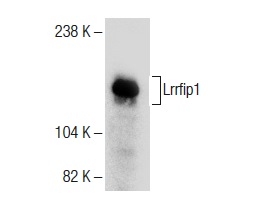
Western blot analysis of Lrrfip1 expression in KNRK whole cell lysate.Application
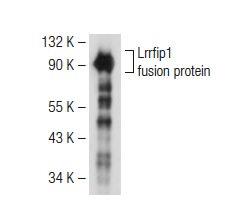
Western blot analysis of rat recombinant Lrrfip fusion protein.| Product Name | Lrrfip1 Antibody (R-300) |
|---|---|
| Antibody Type | Primary Antibodies |
| Modification Notes | LRRFIP1 (also designated GCF2) is an 738 amino acid human protein whose rodent counterpart is known as Lrrfip1 (also designated FLAP in mouse). LRRFIP1 is a transcriptional repressor which will preferentially bind to the GC-rich consensus sequence (5'-AGCCCCCGGCG-3') and may also regulate expression of TNF, EGFR and PDGF-A. LRRFIP1 is also believed to control smooth muscle cell proliferation following arterial injury through PDGF-A repression. The N-terminus of LRRFIP1 shows high homology to the coiled-coil domain of FLAP, a protein which binds the leucine-rich repeat (LRR) of Flightless I, and the interaction of LRRFIP1 with the LRR of Flightless I has been confirmed. LRRFIP1 does not bind single-stranded DNA or RNA significantly and binds double-stranded DNA weakly. In contrast, LRRFIP1 binds double-stranded RNA with high affinity, and two molecules of LRRFIP1 bind the TaR stem. The RNA binding domain has been identified and encompasses a lysine-rich motif. Flightless I has a C-terminal TaR-like domain which binds Actin and therefore the association of LRRFIP1 with the LRR of Flightless I may provide a link between the Actin cytoskeleton and RNA in mammalian cells. |
| Clonality | Polyclonal |
|---|---|
| Isotype | IgG |
| Host Species | Rabbit |
| Tested Applications | WBIPIFELISAGSChIP |
| recommended for detection of Lrrfip1 of rat origin by WB, IP, IF and ELISA | |
| Species Reactivity | HumanMouseRat |
| Concentration | 1mg/ml |
| Purification | Affinity purified |
| Alternative Names | epitope corresponding to amino acids 241-540 mapping within an internal region of Lrrfip1 of rat origin |
|---|---|
| Tissue Specificity | epitope corresponding to amino acids 241-540 mapping within an internal region of Lrrfip1 of rat origin |
Application
Western blot analysis of Lrrfip1 expression in KNRK whole cell lysate.
Application
Western blot analysis of rat recombinant Lrrfip fusion protein.| Application Notes | recommended for detection of Lrrfip1 of rat origin by WB, IP, IF and ELISA |
|---|
| Form | Liquid |
|---|---|
| Storage Instructions | For short-term storage, store at 4° C. For long-term storage, aliquot and store at -20ºC or below. Avoid multiple freeze-thaw cycles. |
| Storage Buffer | phosphate buffered saline , pH 7.4, 150mM NaCl, 0.02% sodium azide and 50% glycerol. |


