Application
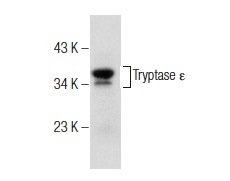
Western blot analysis of Tryptase ε expression in Mv 1 Lu whole cell lysate.| Product Name | Tryptase ε Antibody (H-55) |
|---|---|
| Antibody Type | Primary Antibodies |
| Antigen Alias | epitope corresponding to amino acids 108-160 mapping within an internal region of Tryptase ε of human origin |
| Modification Notes | Tryptase é, also known as brain-specific serine protease 4 (BSSP-4) or serine protease 22, is a member of the human 16p13.3 family of serine proteases. It is expressed in a developmentally regulated manner in esophagus, trachea and lung. Tryptase é is a major product of the normal pulmonary epithelial cells. It is secreted as an active enzyme and, unlike other family members, Tryptase é can autoactivate. Tryptase é, once activated, cannot effectively be inhibited by the protease inhibitors that are found in normal plasma. It is a potent activator of uPA (urokinase-type plasminogen activator precursor), a serine protease that is responsible for cleaving plasminogen. Tryptase é converts uPA into its mature, enzymatically active form and therefore plays an important role in fibrinolysis, connective tissue remodeling and innate immunity. |
| Clonality | Polyclonal |
|---|---|
| Isotype | IgG |
| Host Species | Rabbit |
| Tested Applications | WBIPIFELISA |
| recommended for detection of Tryptase ε of mouse, rat and human origin by WB, IP, IF and ELISA also reactive with additional species, including equine, bovine and porcine: |
|
| Species Reactivity | HumanMouseRat |
| Concentration | 1mg/ml |
| Purification | Affinity purified |
| Alternative Names | epitope corresponding to amino acids 108-160 mapping within an internal region of Tryptase &epsilon of human origin |
|---|---|
| Tissue Specificity | epitope corresponding to amino acids 108-160 mapping within an internal region of Tryptase ε of human origin |
| Entrez Gene | 64063 |
|---|
Application
Western blot analysis of Tryptase ε expression in Mv 1 Lu whole cell lysate.| Application Notes | recommended for detection of Tryptase ε of mouse, rat and human origin by WB, IP, IF and ELISA also reactive with additional species, including equine, bovine and porcine: |
|---|
| Form | Liquid |
|---|---|
| Storage Instructions | For short-term storage, store at 4° C. For long-term storage, aliquot and store at -20ºC or below. Avoid multiple freeze-thaw cycles. |
| Storage Buffer | phosphate buffered saline , pH 7.4, 150mM NaCl, 0.02% sodium azide and 50% glycerol. |


