Application
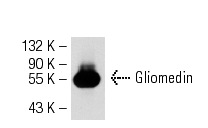
Western blot analysis of Gliomedin expression in rat sciatic nerve tissue extract.| Product Name | Gliomedin Antibody (H-171) |
|---|---|
| Antibody Type | Primary Antibodies |
| Antigen Alias | epitope corresponding to amino acids 452-551 mapping within a C-terminal extracellular domain of Gliomedin of human origin |
| Modification Notes | Gliomedin is a 551 amino acid protein encoded by the human gene GLDN. Gliomedin is thought to play a role in the formation of the nodes of Ranvier along myelinated axons. Accumulation of Na+ channels at the nodes of Ranvier is a prerequisite for saltatory conduction. In peripheral nerves, clustering of these channels along the axolemma is regulated by myelinating Schwann cells through an unknown mechanism. Gliomedin is a glial ligand for Neurofascin and NrCAM, two axonal immunoglobulin cell adhesion molecules that are associated with Na+ channels at the nodes of Ranvier. Gliomedin is expressed by myelinating Schwann cells and accumulates at the edges of each myelin segment during development, where it aligns with the forming nodes. Gliomedin is a single-pass type II membrane protein localized to the nodes of Ranvier and is specifically expressed in spinal cord, brain, placenta and sciatic nerve. It is more abundant in peripheral than central nervous system. |
| Clonality | Polyclonal |
|---|---|
| Isotype | IgG |
| Host Species | Rabbit |
| Tested Applications | WBIPIFELISA |
| recommended for detection of Gliomedin of mouse, rat and human origin by WB, IP, IF and ELISA also reactive with additional species, including canine, bovine and porcine: |
|
| Species Reactivity | HumanMouseRat |
| Concentration | 1mg/ml |
| Purification | Affinity purified |
| Alternative Names | epitope corresponding to amino acids 452-551 mapping within a C-terminal extracellular domain of Gliomedin of human origin |
|---|---|
| Tissue Specificity | epitope corresponding to amino acids 452-551 mapping within a C-terminal extracellular domain of Gliomedin of human origin |
| Entrez Gene | 342035 |
|---|
Application
Western blot analysis of Gliomedin expression in rat sciatic nerve tissue extract.| Application Notes | recommended for detection of Gliomedin of mouse, rat and human origin by WB, IP, IF and ELISA also reactive with additional species, including canine, bovine and porcine: |
|---|
| Form | Liquid |
|---|---|
| Storage Instructions | For short-term storage, store at 4° C. For long-term storage, aliquot and store at -20ºC or below. Avoid multiple freeze-thaw cycles. |
| Storage Buffer | phosphate buffered saline , pH 7.4, 150mM NaCl, 0.02% sodium azide and 50% glycerol. |


