Application
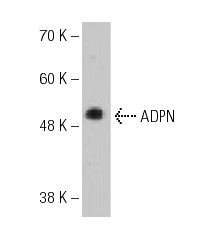
Western blot analysis of ADPN expression in Jurkat whole cell lysate.Application
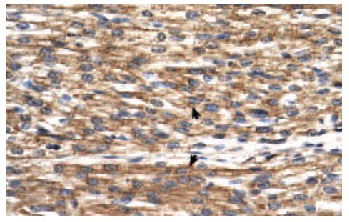
Immunoperoxidase staining of formalin-fixed, paraffin-embedded human heart tissue showing cytoplasmic and membrane localization..| Product Name | ADPN Antibody (F-21) |
|---|---|
| Antibody Type | Primary Antibodies |
| Antigen Alias | recommended for detection of ADPN of human origin by WB, IP, IF, IHC(P) and ELISA |
| Modification Notes | ADPN, a member of the Adiponutrin family, displays lipase activity that is dependent upon the presence of an activated serine residue. D-glucose elicits a 7-fold increase in ADPN mRNA levels, and insulin has a slight effect on ADPN expression in the presence or absence of glucose. The glucose-induced increase in ADPN expression can be reversed by factors known to raise intracellular cAMP. mRNA ADPN levels are negatively correlated with fasting glucose levels and subjects with high ADPN mRNA levels have increased insulin sensitivity, implicating ADPN in obesity and diabetes. ADPN gene expression in humans is highly regulated by changes in energy balance. In mice adipocytes, ADPN parallels the expression of fatty acid synthase (FAS) and Srebp1c, a variant of Srebp1. |
| Clonality | Polyclonal |
|---|---|
| Isotype | IgG |
| Host Species | Rabbit |
| Tested Applications | WBIPIFIHCELISA |
| WB:1:500~1:2000 IP:1:100~1:500 IF:1:200~1:500 IHC:1:50~1:200 Notes:Optimal dilutions/concentrations should be determined by the researcher. |
|
| Species Reactivity | HumanMouseRat |
| Concentration | 1mg/ml |
| Purification | Affinity purified |
| Alternative Names | recommended for detection of ADPN of human origin by WB IP IF IHC(P) and ELISA |
|---|---|
| Tissue Specificity | recommended for detection of ADPN of human origin by WB, IP, IF, IHC(P) and ELISA |
| Entrez Gene | 80339 |
|---|
Application
Western blot analysis of ADPN expression in Jurkat whole cell lysate.
Application
Immunoperoxidase staining of formalin-fixed, paraffin-embedded human heart tissue showing cytoplasmic and membrane localization..| Application Notes | WB:1:500~1:2000 IP:1:100~1:500 IF:1:200~1:500 IHC:1:50~1:200 Notes:Optimal dilutions/concentrations should be determined by the researcher. |
|---|
| Form | Liquid |
|---|---|
| Storage Instructions | For short-term storage, store at 4° C. For long-term storage, aliquot and store at -20ºC or below. Avoid multiple freeze-thaw cycles. |
| Storage Buffer | phosphate buffered saline , pH 7.4, 150mM NaCl, 0.02% sodium azide and 50% glycerol. |


