Application
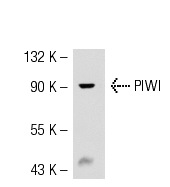
Western blot analysis of PIWI expression in Schneider's Drosophila line 2 whole cell lysate.| Product Name | PIWI Antibody (d-190) |
|---|---|
| Antibody Type | Primary Antibodies |
| Modification Notes | The PIWI family is an evolutionarily conserved gene family that plays an essential role in stem cell self-renewal, gametogenesis, and RNA interference in diverse organisms (1-4). In the Drosophila ovary, PIWI is required for the asymmetric division of Germ-line stem cells (GSCs) to produce and maintain a daughter GSC, but is not essential for the further differentiation of the committed daughter cell (3). PIWI is a highly basic nucleoplasmic protein present in both somatic and germline cells, with the highly conserved C-terminal region essential for its function (3,5). Removing PIWI protein from single germline stem cells significantly decreases the rate of their division, suggesting that PIWI has a second role as a cell-autonomous promoter of germline stem cell division (5). Consistent with its dual function, over-expression of PIWI in somatic cells causes an increase both in the number of germline stem cells and the rate of their division (5). Thus, PIWI is a key regulator of stem cell division; its somatic expression modulates the number of germline stem cells and the rate of their division, while its germline expression also contributes to promoting stem cell division in a cell-autonomous manner (5). |
| Clonality | Polyclonal |
|---|---|
| Isotype | IgG |
| Host Species | Rabbit |
| Tested Applications | WBIPIFELISA |
| recommended for detection of PIWI of Drosophila origin by WB, IP, IF and ELISA | |
| Species Reactivity | HumanMouseRat |
| Concentration | 1mg/ml |
| Purification | Affinity purified |
| Alternative Names | epitope corresponding to amino acids 1-190 mapping at the N-terminus of PIWI of Drosophila melanogaster origin |
|---|---|
| Tissue Specificity | epitope corresponding to amino acids 1-190 mapping at the N-terminus of PIWI of Drosophila melanogaster origin |
Application
Western blot analysis of PIWI expression in Schneider's Drosophila line 2 whole cell lysate.| Application Notes | recommended for detection of PIWI of Drosophila origin by WB, IP, IF and ELISA |
|---|
| Form | Liquid |
|---|---|
| Storage Instructions | For short-term storage, store at 4° C. For long-term storage, aliquot and store at -20ºC or below. Avoid multiple freeze-thaw cycles. |
| Storage Buffer | phosphate buffered saline , pH 7.4, 150mM NaCl, 0.02% sodium azide and 50% glycerol. |


