Application
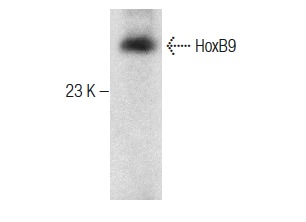
Western blot analysis of HoxB9 expression in human heart tissue extract.| Product Name | HoxB9 Antibody (H-80) |
|---|---|
| Antibody Type | Primary Antibodies |
| Antigen Alias | epitope corresponding to amino acids 101-180 mapping within an internal region of HoxB9 of human origin |
| Modification Notes | The Hox proteins play a role in development and cellular differentiation by regulating downstream target genes. Specifically, the Hox proteins direct DNA-protein and protein-protein interactions that assist in determining the morphologic features associated with the anterior-posterior body axis. The mammalian HOX gene complex consists of 39 genes that are located on 4 linkage groups, which are dispersed over 4 chromosomes. HOX genes that occupy the same relative position along the 5’ to 3’ coordinate (trans-paralogous genes) are more similar in sequence and expression pattern than adjacent HOX genes on the same chromosome. In mice, the HoxB cluster contains HoxB1 to HoxB9 and HoxB13, which are transcribed in the same direction. HoxB9 associates with the transcriptional cofactors BTG1 and BTG2, which enhance HoxB9 transcription. Alterations in HoxB9 expression, as with other Hox family member, has been implicated in leukemia. |
| Clonality | Polyclonal |
|---|---|
| Isotype | IgG |
| Host Species | Rabbit |
| Tested Applications | WBIPIFELISAGSChIP |
| recommended for detection of HoxB9 of mouse, rat and human origin by WB, IP, IF and ELISA also reactive with additional species, including canine, bovine and porcine: |
|
| Species Reactivity | HumanMouseRat |
| Concentration | 1mg/ml |
| Purification | Affinity purified |
| Alternative Names | epitope corresponding to amino acids 101-180 mapping within an internal region of HoxB9 of human origin |
|---|---|
| Tissue Specificity | epitope corresponding to amino acids 101-180 mapping within an internal region of HoxB9 of human origin |
| Entrez Gene | 3219 |
|---|
Application
Western blot analysis of HoxB9 expression in human heart tissue extract.| Application Notes | recommended for detection of HoxB9 of mouse, rat and human origin by WB, IP, IF and ELISA also reactive with additional species, including canine, bovine and porcine: |
|---|
| Form | Liquid |
|---|---|
| Storage Instructions | For short-term storage, store at 4° C. For long-term storage, aliquot and store at -20ºC or below. Avoid multiple freeze-thaw cycles. |
| Storage Buffer | phosphate buffered saline , pH 7.4, 150mM NaCl, 0.02% sodium azide and 50% glycerol. |


