Application
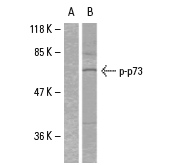
Western blot analysis of phosphorylated p73 expression in untreated (A) and vanadate-treated (B) K-562 whole cell lysates.| Product Name | p-p73 Antibody (Tyr 99) |
|---|---|
| Antibody Type | Primary Antibodies |
| Antigen Alias | epitope corresponding to phosphorylated Tyr 99 of p73 of human origin |
| Modification | Phosphoralated |
| Modification Notes | The p53 gene is a widely studied anti-oncogene, or tumor suppressor gene. The p53 gene product can act as a negative regulator of cell growth in response to DNA damage. Mutations and allelic loss of the p53 gene have been associated with malignant transformation in a wide variety of human tumors. p53 shares considerable sequence similarity with p73, a gene that maps to a region in chromosome 1 that is frequently deleted in neuroblastomas. However, p73 does not appear to be activated by DNA damaging agents. The p73 isoform p73å inhibits drug-induced apoptosis in small cell lung carcinoma cells, while the p73 isoform p73∫ promotes it. p73å also prevents Bax activation, mitochondrial dysfunction, caspase activation and is able to reduce apoptosis induced by the BH3-only protein PUMA (p53 upregulated modulator of apoptosis). There is an equilibrium between p73å and p73∫, demonstrated by the fact that p73å inhibits the pro-apoptotic effect of p73∫. |
| Clonality | Polyclonal |
|---|---|
| Isotype | IgG |
| Host Species | Rabbit |
| Tested Applications | WBIP |
| recommended for detection of Tyr 99 phosphorylated p73 of human origin correspondingly phosphorylated Tyr 91 of mouse origin and correspondingly phosphorylated Tyr 144 of rat origin by WB and IP: |
|
| Species Reactivity | HumanMouseRat |
| Concentration | 1mg/ml |
| Purification | Affinity purified |
| Alternative Names | epitope corresponding to phosphorylated Tyr 99 of p73 of human origin |
|---|---|
| Tissue Specificity | epitope corresponding to phosphorylated Tyr 99 of p73 of human origin |
| Entrez Gene | 7161 |
|---|
Application
Western blot analysis of phosphorylated p73 expression in untreated (A) and vanadate-treated (B) K-562 whole cell lysates.| Application Notes | recommended for detection of Tyr 99 phosphorylated p73 of human origin correspondingly phosphorylated Tyr 91 of mouse origin and correspondingly phosphorylated Tyr 144 of rat origin by WB and IP: |
|---|
| Form | Liquid |
|---|---|
| Storage Instructions | For short-term storage, store at 4° C. For long-term storage, aliquot and store at -20ºC or below. Avoid multiple freeze-thaw cycles. |
| Storage Buffer | phosphate buffered saline , pH 7.4, 150mM NaCl, 0.02% sodium azide and 50% glycerol. |


