Application
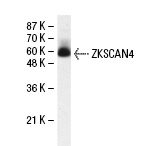
Western blot analysis of ZKSCAN4 expression in transfected 293T whole cell lysate.| Product Name | ZKSCAN4 Antibody (V-16) |
|---|---|
| Antibody Type | Primary Antibodies |
| Antigen Alias | raised against ZKSCAN4 of human origin |
| Modification Notes | Zinc-finger proteins contain DNA-binding domains and have a wide variety of functions, most of which encompass some form of transcriptional activation or repression. ZKSCAN4 (Zinc finger protein with KRAB and SCAN domains 4), also known as ZNF307, is a 545 amino acid protein belonging to the Krüppel C2H2-type zinc-finger protein family. Localized to the nucleus, ZKSCAN4 is expressed in placenta, lung, kidney, brain and heart, as well as in embryonic (17-week) liver, brain, heart, small intestine and skeletal muscle. ZKSCAN4 functions as a transcription repressor and has been shown to suppress both p53 and p21 transcription. Overexpression of ZKSCAN4 results in the upregulation of p300 and MDM2 genes, suggesting that ZKSCAN4 suppresses the p53-p21 pathway by activating p300 and MDM2 expression, which then leads to the degradation of p53. Phosphorylation on Ser165 of human ZKSCAN4 occurs upon DNA damage, most likely by Atm or ATR. |
| Clonality | Polyclonal |
|---|---|
| Isotype | IgG |
| Host Species | Rabbit |
| Tested Applications | WBIPELISA |
| recommended for detection of ZKSCAN4 of human origin by WB, IP and ELISA: |
|
| Species Reactivity | HumanMouseRat |
| Concentration | 1mg/ml |
| Purification | Affinity purified |
| Alternative Names | raised against ZKSCAN4 of human origin |
|---|---|
| Tissue Specificity | raised against ZKSCAN4 of human origin |
| Entrez Gene | 387032 |
|---|
Application
Western blot analysis of ZKSCAN4 expression in transfected 293T whole cell lysate.| Application Notes | recommended for detection of ZKSCAN4 of human origin by WB, IP and ELISA: |
|---|
| Form | Liquid |
|---|---|
| Storage Instructions | For short-term storage, store at 4° C. For long-term storage, aliquot and store at -20ºC or below. Avoid multiple freeze-thaw cycles. |
| Storage Buffer | phosphate buffered saline , pH 7.4, 150mM NaCl, 0.02% sodium azide and 50% glycerol. |


