Application
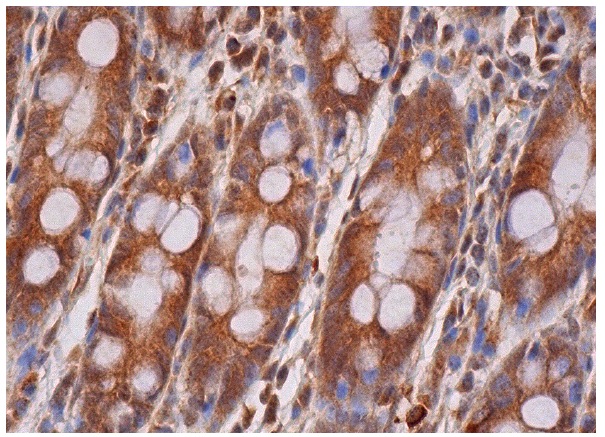
Immunoperoxidase staining of formalin fixed, paraffin-embedded human rectum tissue showing cytoplasmic staining of glandular cells.| Product Name | LOXL2 Antibody (H-65) |
|---|---|
| Antibody Type | Primary Antibodies |
| Antigen Alias | epitope corresponding to amino acids 161-225 mapping within an internal region of LOXL2 of human origin |
| Modification Notes | Lysyl oxidase (LOX) proteins belong to a family of enzymes that oxidize primary amine substrated to reactive aldehydes. In fibrillar collagens and elastin, LOX catalyzes the lysine-derived cross-links of collagen fibrils and insoluble elastic fibers in the extracellular matrix. LOX is involved in tumor suppression, cell motility, cellular senescence and developmental regulation. There are four homologs of LOX, lysyl oxidase-like proteins, designated LOX-like (LOXL1-LOXL4) proteins. LOXL2 is an extracellular protein that localizes specifically to sites of elastogenesis. It serves as a cross-linking enzyme, controlling the deposition of elastin and interacts with Fibulin-5. LOXL2 and LOXL3 can interact and cooperate with the Snail protein to downregulate E-cadherin expression. In epithelial cells, overexpression of LOXL2 or LOXL3 may induce an epithelial-mesenchymal transitions process, an important element in tumor progression. Knockdown of the LOXL2 protein significantly decreases tumor growth. |
| Clonality | Polyclonal |
|---|---|
| Isotype | IgG |
| Host Species | Rabbit |
| Tested Applications | WBIPIFIHCELISA |
| recommended for detection of LOXL2 of mouse, rat and human origin by WB, IP, IF, IHC(P) and ELISA also reactive with additional species, including equine, canine and bovine: |
|
| Species Reactivity | HumanMouseRat |
| Concentration | 1mg/ml |
| Purification | Affinity purified |
| Alternative Names | epitope corresponding to amino acids 161-225 mapping within an internal region of LOXL2 of human origin |
|---|---|
| Tissue Specificity | epitope corresponding to amino acids 161-225 mapping within an internal region of LOXL2 of human origin |
| Entrez Gene | 4017 |
|---|
Application
Immunoperoxidase staining of formalin fixed, paraffin-embedded human rectum tissue showing cytoplasmic staining of glandular cells.| Application Notes | recommended for detection of LOXL2 of mouse, rat and human origin by WB, IP, IF, IHC(P) and ELISA also reactive with additional species, including equine, canine and bovine: |
|---|
| Form | Liquid |
|---|---|
| Storage Instructions | For short-term storage, store at 4° C. For long-term storage, aliquot and store at -20ºC or below. Avoid multiple freeze-thaw cycles. |
| Storage Buffer | phosphate buffered saline , pH 7.4, 150mM NaCl, 0.02% sodium azide and 50% glycerol. |


