Application
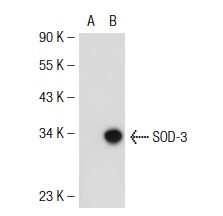
Western blot analysis of SOD-3 expression in non-transfected: (A) and mouse SOD-3 transfected: (B) 293T whole cell lysates.| Product Name | SOD-3 Antibody (M-106) |
|---|---|
| Antibody Type | Primary Antibodies |
| Antigen Alias | epitope corresponding to amino acids 25-130 mapping near the N-terminus of SOD-3 of mouse origin |
| Modification Notes | The superoxide dismutase family is composed of three metalloenzymes (SOD-1, SOD-2 and SOD-3) that catalyze the oxido-reduction of reactive oxygen species (ROS) such as superoxide anion. ROS are implicated in a wide range of degenerative processes, including Alzheimer’s disease, Parkinson’s disease and ischemic heart disease. Cu/Zn superoxide dismutase-1 (SOD-1) is a well characterized cytosolic scavenger of oxygen free radicals that requires copper and zinc binding to potentiate its enzymatic activity. The SOD-2 precursor is a 222 amino acid protein that is encoded by nuclear chromatin, synthesized in the cytosol and imported posttranslationally into the mitochondrial matrix. SOD-3, also designated extracellular superoxide dismutase (EC-SOD), is an extracellular zinc and copper binding protein that destroys radicals that are toxic to biological systems but that are normally produced within cells. SOD-3 is found in extracellular fluids such as lymph, plasma and synovial fluid. |
| Clonality | Polyclonal |
|---|---|
| Isotype | IgG |
| Host Species | Rabbit |
| Tested Applications | WBIPIFELISA |
| recommended for detection of SOD-3 of mouse and, to a lesser extent, rat origin by WB, IP, IF and ELISA: |
|
| Species Reactivity | HumanMouseRat |
| Concentration | 1mg/ml |
| Purification | Affinity purified |
| Alternative Names | epitope corresponding to amino acids 25-130 mapping near the N-terminus of SOD-3 of mouse origin |
|---|---|
| Tissue Specificity | epitope corresponding to amino acids 25-130 mapping near the N-terminus of SOD-3 of mouse origin |
| Entrez Gene | 20657 |
|---|
Application
Western blot analysis of SOD-3 expression in non-transfected: (A) and mouse SOD-3 transfected: (B) 293T whole cell lysates.| Application Notes | recommended for detection of SOD-3 of mouse and, to a lesser extent, rat origin by WB, IP, IF and ELISA: |
|---|
| Form | Liquid |
|---|---|
| Storage Instructions | For short-term storage, store at 4° C. For long-term storage, aliquot and store at -20ºC or below. Avoid multiple freeze-thaw cycles. |
| Storage Buffer | phosphate buffered saline , pH 7.4, 150mM NaCl, 0.02% sodium azide and 50% glycerol. |


