Application
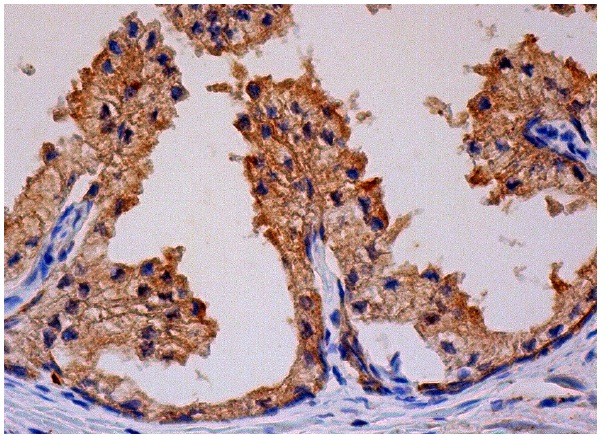
Immunoperoxidase staining of formalin fixed, paraffin-embedded human prostate tissue showing cytoplasmic staining of glandular cells.| Product Name | Nox5 Antibody (H-160) |
|---|---|
| Antibody Type | Primary Antibodies |
| Antigen Alias | epitope corresponding to amino acids 606-765 mapping within a C-terminal extracellular domain of Nox5 of human origin |
| Modification Notes | The superoxide-generating NADPH oxidase includes a membrane-bound flavocytochrome containing two subunits (gp91 phox and p22 phox) and the cytosolic proteins p47 phox and p67 phox. During activation of the NADPH oxidase, p47 phox and p67 phox migrate to the plasma membrane, where they associate with the flavocytochrome cytochrome b558 to form the active enzyme complex. The p22 and gp91 phox subunits also function as surface O2 sensors that initiate cellular signaling in response to hypoxic conditions. NADPH oxidase 5 (Nox5) is a homolog of the gp91 phox subunit of the phagocyte NADPH oxidase. Nox5 is expressed in lymphoid organs and testis and is distinguished from the other NADPH oxidases by its unique N-terminus, which contains three canonical EF-hands, Ca2+-binding domains. Upon heterologous expression, Nox5 generates superoxide in response to intracellular Ca2+ elevations. |
| Clonality | Polyclonal |
|---|---|
| Isotype | IgG |
| Host Species | Rabbit |
| Tested Applications | WBIPIFIHCELISA |
| recommended for detection of Nox5 of human origin by WB, IP, IF, IHC(P) and ELISA also reactive with additional species, including equine, canine and bovine: |
|
| Species Reactivity | HumanMouseRat |
| Concentration | 1mg/ml |
| Purification | Affinity purified |
| Alternative Names | epitope corresponding to amino acids 606-765 mapping within a C-terminal extracellular domain of Nox5 of human origin |
|---|---|
| Tissue Specificity | epitope corresponding to amino acids 606-765 mapping within a C-terminal extracellular domain of Nox5 of human origin |
| Entrez Gene | 79400 |
|---|
Application
Immunoperoxidase staining of formalin fixed, paraffin-embedded human prostate tissue showing cytoplasmic staining of glandular cells.| Application Notes | recommended for detection of Nox5 of human origin by WB, IP, IF, IHC(P) and ELISA also reactive with additional species, including equine, canine and bovine: |
|---|
| Form | Liquid |
|---|---|
| Storage Instructions | For short-term storage, store at 4° C. For long-term storage, aliquot and store at -20ºC or below. Avoid multiple freeze-thaw cycles. |
| Storage Buffer | phosphate buffered saline , pH 7.4, 150mM NaCl, 0.02% sodium azide and 50% glycerol. |


