Application
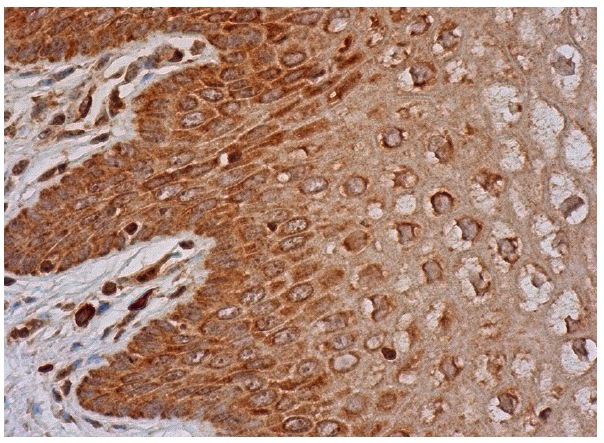
Immunoperoxidase staining of formalin fixed, paraffin-embedded human vagina tissue showing cytoplasmic and nuclear staining of squamous epithelial cells.| Product Name | SENP1 Antibody (H-65) |
|---|---|
| Antibody Type | Primary Antibodies |
| Antigen Alias | epitope corresponding to amino acids 361-425 mapping within an internal region of SENP1 of human origin |
| Modification Notes | SUMO (small ubiquitin-related modifier), a member of the ubiquitin-like protein family, regulates diverse cellular functions of a variety of target proteins, including transcription, DNA repair, nucleocytoplasmic trafficking and chromosome segregation. SUMO precursor proteins undergo cleavage of the residues after the “GG” region by SUMO-specific proteases in maturation. This cleavage of the precursor is a prerequisite for subsequent sumoylation. The sentrin-specific (or SUMO-specific) protease (SENP) proteins belong to the peptidase C48 family and include SENP1-3 and SENP5-8. SENP1, SENP2 and SENP3 degrade UBL1 and SMT3H2 conjugates and subsequently release the monomers from sumoylated substrates. HIPK2 is a desumoylation target for SENP1 which shuttles between the cytoplasm and the nucleus. Mutation analyses reveal that SENP1 contains the nuclear export sequence (NES) within the extreme carboxyl-terminal region, and SENP1 is exported to the cytoplasm in a NES-dependent manner. SENP2 has been implicated as a downregulator of CTNNB1 levels and may therefore be a modulator of the Wnt pathway. SUMO protease SENP3 reverses the sumoylation of MEF2 to augment its transcriptional and myogenic activities. SENP5 localizes to the nucleolus and preferentially processes SUMO-3. It is thought to play a role in mitosis and/or cytokinesis. SENP6 localizes to the cytoplasm and releases SUMO-1. Expression of SENP6 is higher in reproductive organs, indicating that it may mediate processes related to reproduction. SENP8 is involved in the release of sentrins. |
| Clonality | Polyclonal |
|---|---|
| Isotype | IgG |
| Host Species | Rabbit |
| Tested Applications | WBIPIFIHCELISA |
| recommended for detection of SENP1 of mouse, rat and human origin by WB, IP, IF, IHC(P) and ELISA also reactive with additional species, including equine, canine, bovine and porcine: |
|
| Species Reactivity | HumanMouseRat |
| Concentration | 1mg/ml |
| Purification | Affinity purified |
| Alternative Names | epitope corresponding to amino acids 361-425 mapping within an internal region of SENP1 of human origin |
|---|---|
| Tissue Specificity | epitope corresponding to amino acids 361-425 mapping within an internal region of SENP1 of human origin |
| Entrez Gene | 29843 |
|---|
Application
Immunoperoxidase staining of formalin fixed, paraffin-embedded human vagina tissue showing cytoplasmic and nuclear staining of squamous epithelial cells.| Application Notes | recommended for detection of SENP1 of mouse, rat and human origin by WB, IP, IF, IHC(P) and ELISA also reactive with additional species, including equine, canine, bovine and porcine: |
|---|
| Form | Liquid |
|---|---|
| Storage Instructions | For short-term storage, store at 4° C. For long-term storage, aliquot and store at -20ºC or below. Avoid multiple freeze-thaw cycles. |
| Storage Buffer | phosphate buffered saline , pH 7.4, 150mM NaCl, 0.02% sodium azide and 50% glycerol. |


