Application
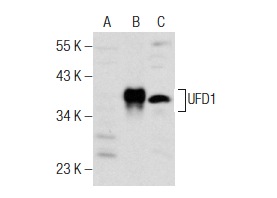
Western blot analysis of UFD1 expression in non-transfected 293T: (A), mouse UFD1 transfected 293T: (B) and K-562 (C) whole cell lysates.| Product Name | UFD1 Antibody (H-127) |
|---|---|
| Antibody Type | Primary Antibodies |
| Antigen Alias | epitope corresponding to amino acids 181-307 mapping at the C-terminus of UFD1 of human origin |
| Modification Notes | Ubiquitin-mediated proteolysis requires the transfer of ubiquitin (Ub) to lysine groups on selected cellular proteins, which then potentiates the proteolytic degradation of these protein conjugates by the 26S proteasome. Ub-fusions are cleaved by Ub-specific processing proteases (UBps) or alternatively by the Ub-fusion degradation (UFD) pathway (2,3). The UBP pathway targets the C-terminal glycine residue on Ub that is involved in the formation of Ub-conjugates, while UFD proteins preferentially cleave Ub-conjugated proteins that contain an amino acid substitution at this glycine residue (4). The UFD1 protein was originally characterized in the yeast S. cerevisiae and subsequently, the human homolog UFD1 or UFD1L was identified (5). In vitro, UFD1 attenuates the degradation of Ub-fusions, which have a proline or valine residue substituted at the Gly76 moiety, by the selective multiubiquitination of the Ub chain of the Ub-conjugate. Mutations within the UFD1 gene are implicated in the development of CATCH22 syndrome, which is characterized by cardiac defects, cleft palate and hypocalcemia, suggesting that this proteolytic pathway may be involved in the progression of these developmental defects (6). |
| Clonality | Polyclonal |
|---|---|
| Isotype | IgG |
| Host Species | Rabbit |
| Tested Applications | WBIPIFELISA |
| suitable control antibody: : sc-UFD1 (m): 293T Lysate: |
|
| Species Reactivity | HumanMouseRat |
| Concentration | 1mg/ml |
| Purification | Affinity purified |
| Alternative Names | epitope corresponding to amino acids 181-307 mapping at the C-terminus of UFD1 of human origin |
|---|---|
| Tissue Specificity | epitope corresponding to amino acids 181-307 mapping at the C-terminus of UFD1 of human origin |
| Entrez Gene | 7353 |
|---|
Application
Western blot analysis of UFD1 expression in non-transfected 293T: (A), mouse UFD1 transfected 293T: (B) and K-562 (C) whole cell lysates.| Application Notes | suitable control antibody: : sc-UFD1 (m): 293T Lysate: |
|---|
| Form | Liquid |
|---|---|
| Storage Instructions | For short-term storage, store at 4° C. For long-term storage, aliquot and store at -20ºC or below. Avoid multiple freeze-thaw cycles. |
| Storage Buffer | phosphate buffered saline , pH 7.4, 150mM NaCl, 0.02% sodium azide and 50% glycerol. |


